|
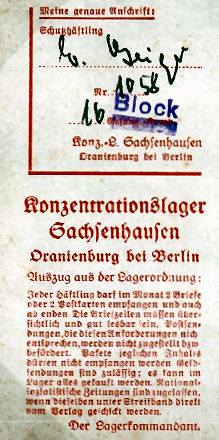
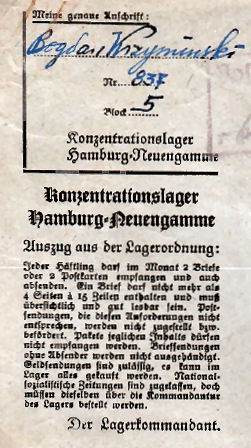
Inmates at Auschwitz could
write letters on a limited basis from the concentration
camp. On the left is an example, in German, of the
instructions given to those who would receive these letters.
It should be noted that such instructions were standard, as
I have similar or the same exact instructions imprinted on
cards from other camps such as Buchenwald, Dachau,
Mauthausen, Ravensbrück, Sachsenburg, Sachsenhausen et al.
Sachsenburg concentration camp
was the first concentration camp to provide printed
lettercards for prisoner correspondence, beginning in 1935.
Of course, letters that came into and out of the various
camps had to pass through censors. Often times the actual
stamps on the cards were removed by the censors to see if
there were any secret messages hidden under the stamps.
Here is the text (in German)
that was imprinted on the Sachsenburg mail:
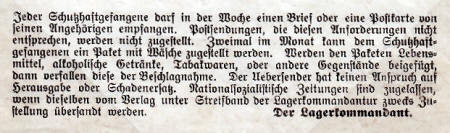
The translation of the
Sachsenburg instructions is:
Every prisoner is allowed
to receive once a week, a letter or a postcard from his
relatives. Post which is not according these
instructions will not be handed over. Twice a month the
prisoner may receive a parcel with clothes. If the
parcels contain food, alcoholics, tobacco or other
objects they will be confiscated. The sender has a claim
for indemnification. National-socialist newspapers are
allowed, if these are sent under tape directly to the
camp commander with the aim of delivering.
The Camp Commandant.

Below is a translation from
the Auschwitz letter card shown above left, though
as stated, the instructions are similar or the same for
other camps.
The following orders must be observed at letter exchanges
with prisoners:
1) Each preventive detention prisoner is allowed to receive
and send each month two letters or (post)cards from his
relatives. The letter to the prisoners must be readable,
written with ink, and can contain only fifteen lines per
sheet. Only normal sized letter sheets are permitted.
Envelopes must not be lined but simple. A single letter can
contain only five stamps of 12 Pfg (= Pfennig). All others
are forbidden and will be seized. Postcards can have only 10
lines.
2) The sending of money is not allowed.
3) It is important that in the sending of post or the
transferring of money, the exact address must consist of the
name, the date of birth, and prisoner's number. If the
address is not exact it will be returned or destroyed.
4) Newspapers are allowed but must be ordered at the post
office of the K.L Auschwitz only. ( K.L = Konzentrations
Lager).
5) Sending of parcels is not allowed since prisoners can buy
anything in the camp.
6) Requests to the direction of the camp to free from
preventive detention (i.e. imprisonment) are pointless.
7) Permission to speak or to meet with prisoners in the
Concentration Camp is absolutely not allowed.
The Camp Commandant. |