|
||
|
|
||
|
||

Great
Artists: David Pinski, Yiddish Playwright
Productions
"The Dumb Messiah"
The Play
House
Cleveland, Ohio
December 1919
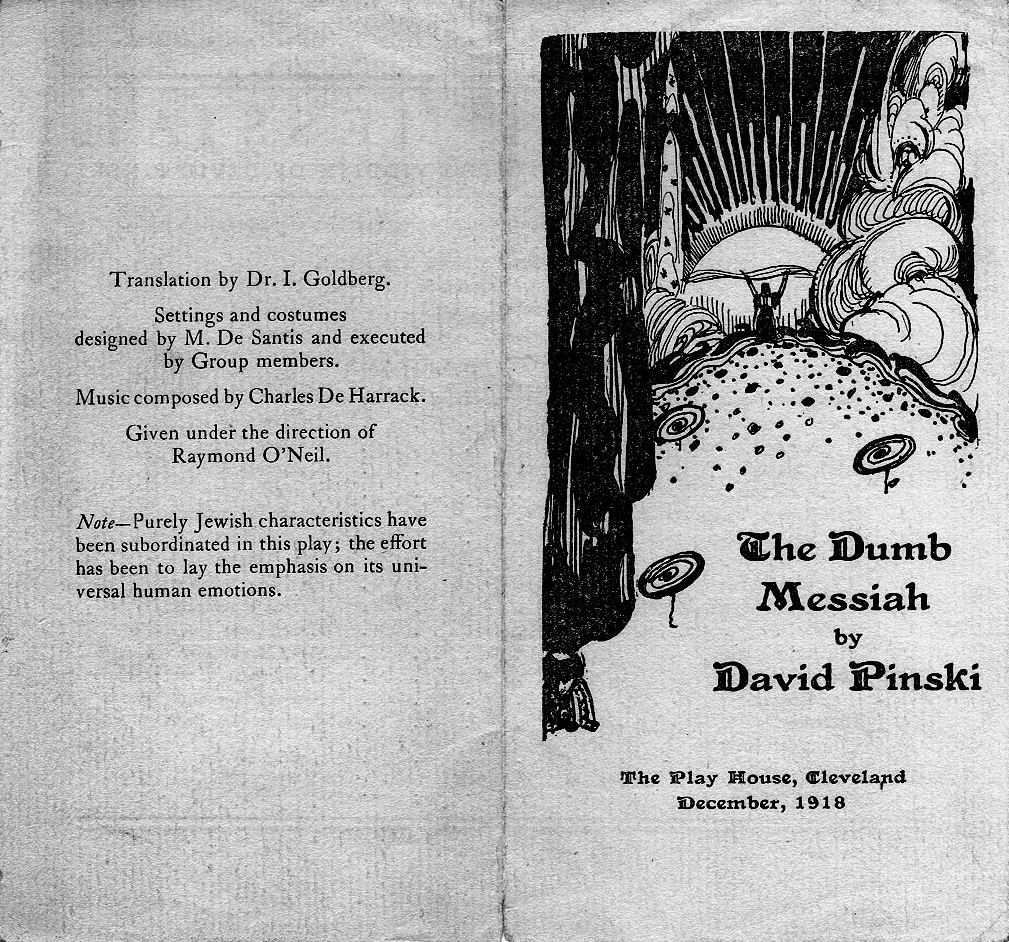 Program Cover |
 Cast |
| ll
in all, David Pinski wrote more than sixty plays in
his lifetime. Perhaps he is best remembered for his
story "The Zwie Family (Di Familye Tsvi)," which he
wrote in 1904. He wrote of the conflict between the
traditional Jewish way of life and the newer
ideologies, i.e. the religious zealot, the Bundists
(socialists), the Zionists, and those who just
wished to assimilate with the general population.
Because of its controversial nature, this play was
not allowed to be published in Russia nor performed
openly, though it was performed by some amateur
troupes in a relatively secretive manner. It has
also been written that Pinski was to receive his
doctorate from Columbia University in German
Literature in 1904, on the day "Di Familye Tsvi" was
to premier. He chose to attend the premier rather
than his doctorate exam, and thus never received his
degree. The "rest is history." Pinski is also well-known for his work "Der Oytser (The Treasure)" written in 1906, a social satire that deals with the obsession with money. It is about the frenzy that occurs when a treasure is said to have been buried in a sacred graveyard, and the townspeople, no matter their financial status or degree of religiosity, participate in digging up the graveyard in search of it. It was first performed in Berlin in German in 1910, staged by the famous director, Max Reinhardt. In 1920, an English-language production of "The Treasure" was staged by the Theatre Guild in New York City, and starred Celia Adler. "The Treasure" was also performed in March 1943 in the Vilna Ghetto. On June 10, 1943, another Pinski play "The Eternal Jew" was performed in the Ghetto. "The Eternal Jew" is about the struggle of the Jewish people against the Roman Empire. The play was reconstructed in Hebrew, because the Germans could not understand the Hebrew. Nahma Sandrow has published a new translation of "The Treasure (Der Oytser)" in her book "God, Man, and Devil", Syracuse University Press,1998. Pinski also wrote "Yenkel the Blacksmith" in 1906. Many remember the film "Yankl der Shmid" made in 1938 and starring the wonderful Cantor Moyshe Oysher. "Yenkel" was the basis for this Yiddish-language film which, by the way, marked the film debut of Herschel Bernardi, who played Yankel when he was a boy. The movie is also known in English as "The Singing Blacksmith." |