|
Rabbi
Aharon Yaakov Klepfish z"l, the Rabbi’s
Son-in-Law
By Y. Meshuli
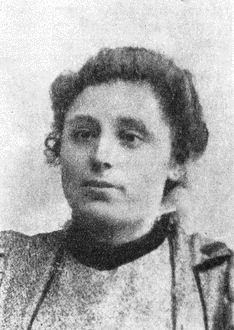
R’ Aharon Yaakov
Klepfish, the Rabbi’s Son-in-Law and his wife,
Sotshe
|
R’
Aharon Yaakov, the Rabbi’s son-in-law, came from a
large, well-branched and prominent family in Warsaw
(his father was a cousin of the Chief Rabbi of
Warsaw, R’ Shmuel Zeinvill). He was born in
Szczuczyn in the year 1880. He was raised in the
home of his maternal grandfather, Rabbi Yehoshua
Heschel Shapiro, the Rabbi of Szczuczyn. When he was
seven years old, his father became a shokhet
in Warsaw, and the family moved to Warsaw. Aharon
Yaakov studied well at the yeshiva there, and had a
special teacher who instructed him in Russian,
Polish, Hebrew and Arithmetic.
When
he was eighteen years old, a marriage contract was
drawn up between him and
Sotshe, the oldest
daughter of the Rabbi of Zambrow. That Rabbi was
also his uncle. Two-and-a half years after this
contract was drawn up, the actual wedding took
place. In the interim, the prospective
bridegroom studied at the yeshiva in Mir and
obtained his rabbinical ordination. After this he
stood for military conscription and was let go. It
was only at that time that he got married and was
supported by his father-in-law for five years. Later
on he opened a business in Zambrow, selling
glassware, porcelain and ‘blue’ ware, that is to
say, it was as if ‘he opened the business.’ In
reality, it was his wife, Sotshe, who ran the
business– he would be sitting in the study house and
be learning or assisting the Rabbi in dealing with
his issues. Someone asked him: Well, R’ Aharon
Yaakov, how is it that you opened up a business
selling glassware? The Gemara says that he
who wishes to lose his money should buy glassware,
to which R’ Aharon Yaakov replied: The Gemara
says ‘who buys glassware,’ not ‘who sells glassware
– and I am selling!’ When he told his rabbi, the
headmaster of the Mir Yeshiva, R’ Eliyahu Baruch
Kamai, that he had opened this business to sell
glassware, he said to him that this was not for him
and it would not succeed. And that is how it was. In
the large fire of 1910 his entire store burned
down, and R’ Aharon Yaakov was left with nothing and
was burdened with a great deal of debt. When he
reestablished the store later there still was
insufficient income from it, and a few years
afterwards he was forced to liquidate it.
In
the year 1913, he became the headmaster of the
yeshiva in Slonim. He was very successful in this
capacity, and earned a very great name; however, the
First World War broke out, and he was compelled to
return to Zambrow.
He
did not rest. Together with his brother-in-law, the
Rabbi’s son, Chaim David (today a rabbi in Chicago),
he rejuvenated the yeshiva in Zambrow and invested
the best of his energies for four years to its
development in Torah study. He looked after paying
the mashgiach and others, arranged for the
yeshiva boys from faraway places to have a place to
take ‘daily meals’ and lodging, while he personally
earned nothing from doing this.
In
1919, he became the Rabbi of Sniadowo – one of the
oldest communities in the entire area, which had
become impoverished over a period of time. He did
not lack for tribulation here. The town was
completely burned down at the beginning of the First
World War by the Germans – but, a little at a time,
the Jews began to return and to rebuild the ruined
structures [of the town]. Rabbi Klepfish did a great
deal for his congregation, seeing to it that it
would receive foodstuffs from the Joint, as well as
money, and he helped to found a credit bank,
obtaining the means to re-build the Bet HaMedrash
(the famous ancient wooden synagogue of Sniadowo had
been burned down during the war), and to found a
Talmud Torah.
In
the year 1935, he and his wife arrive in the Land of
Israel. For one year, he held the pulpit at Kfar
Saba and was outside of the country for purposes of
taking a cure. After that he traveled as an
emissary to America, to raise money for the yeshiva
at Lomza, which had relocated itself to the Land of
Israel in Petakh Tikva.
In
the year 1943, he took up residence in Jerusalem.
Here, he received a very honored position: he was
nominated – at the recommendation of the Chief
Rabbi, Rabbi Herzog
z"l – as an expert
colleague for the work on the: ‘Questions and
Responses’ Encyclopedia. Approximately eighteen
distinguished rabbis and scholars were to be
selected from the great treasure of rabbinic
writings, all of the rulings of law, during the span
of approximately one thousand years. Such a work
could only be carried out by a truly distinguished
scholar, who was thoroughly grounded in Shas
and its commentators. And this was R’ Aharon
Yaakov. He was counted among the senior editors, and
he dedicated eighteen years of work and knowledge into
it. His name became exceedingly well-known in
rabbinical circles. He would also set aside time for
his own personal study. He would rise each day
before dawn for study. He would often engage in
fasting. He would help others with a full heart. Not
a few people benefitted from his personal largesse.
He was a very modest, self-effacing man, and was
possessed of a genteel character. Everyone held him
in great esteem. When he lay ill in hospital, he was
visited by Chief Rabbi Herzog, the Rabbi of Ger, and
other great rabbis. He worked up to the last day of
his life.
On
Friday, 22 Adar 5721 (March 10, 1961) as he was
preparing to go to synagogue to welcome the Sabbath
– he fell and passed away early that Saturday
morning in the hospital. The funeral took place that
Saturday evening, as is the custom in Jerusalem, and
it attracted thousands of people.
His
daughter, Fruma
Liebcheh, was the wife of the renown Yiddish writer
and poet, Chaim
Grade (in America). She was killed in Treblinka by
the Nazis. His son, Moshe, was active in the
Hagana, and served in the Jewish Brigade and
fell as a hero in the War of Independence at the
battle near ‘Bet Keshet,’ in the Lower
Galilee. His wife and three sons live in Israel.
|
|

|
|
Translation of the Text:
To the respected members of
the Organization of Zambrow Émigrés in Israel,
Your
sacred undertaking, and the sacred objective that you
have set for yourselves, to memorialize Jewish Zambrow
and its martyrs, is lofty indeed; it is the right thing,
and good, and I wish you success in your undertaking.
In
this connection, I am sending along a few words about my
father-in-law, may his memory be for a blessing, the
last Rabbi of Zambrow, which was written by my son,
Yehoshua (Heshl).
The
wonderful picture of the Rabbi
is with us, and I will send it
to you, when you require it. With great pleasure, I
will answer all questions that you may need to ask me
about Zambrow.
I will
also contribute to underwriting the expenses for the
book, to the extent that you ask of me.
With great respect, Rabbi Aharon Yaakov Klepfish.
Three sons of the Rabbi live in Chicago. I am sending
you two addresses, and the address of the third,
Israelcheh, is in the possession of Mr. Joseph
Srebrowicz |
|
Above:
Letter sent to the Zambrow Society in
Israel by R’ Aharon Yaakov Klepfish, now
residing in Jerusalem, expressing his warm
feelings towards the idea of publishing the
present Memorial Book and his readiness to
help in the enterprise. |
|
The Dayans
63
R’ Zalman Kaplan
|

Reb Zalman Kaplan,
of blessed memory |
|
He was the son-in-law of Israelkeh Shia-‘Tzaleleh’s
and Liebeh [Rosenthal]. He came from a distinguished
family, counting the Chafetz Chaim64,
and R’ Yehuda HaLevi Epstein as his uncles. He was a
formidable scholar, a Litvak, and one of the best of
the young men from the yeshiva at Volozhin. His
father, R’ Nahum Maggid, the author of ‘Nahamot
Israel,’ made aliyah to Jerusalem in the year 1877.
It was to avoid military service that he came to
Zambrow. He came to Zambrow as a twenty-one year-old
young man, with a recommendation from his uncle, the
‘Chafetz Chaim.’ The [sic: Zambrow] Rabbi was very
much taken by his knowledge of Torah, his wisdom
and his resplendent appearance. He then called on Israelkeh Shia-‘Tzaleleh’s and said: I have here, a
son-in-law, suitable for your daughter Mashkeh, he
is a rare find, and you should grab him!' He pleased
everyone, including his prospective father-in-law
and prospective bride, because he was handsome,
robust, tall, and possessed a pleasant demeanor.
|
At first, he was the Rabbi of Tyszowce. Because
of a dispute that arose between the balebatim and the local
clergy, he gave up the rabbinical seat and came back to Zambrow
to become a dayan. He was a gentle man, never mixing into the
community debates, was one who loved peace and did not follow
in the direction of fanatics. He was a liberal man and would
read newspapers and books. When his children grew somewhat
older, and his salary proved insufficient, he was given a
monopoly to sell candles for sacramental purposes. He died in
the year 1937. He left a daughter in Argentina, and a son and
daughter in Israel.

The Dayan, R’ Zalman Kaplan, with his wife,
Mashkeh k”z, his son Pinchas, and his two daughters.
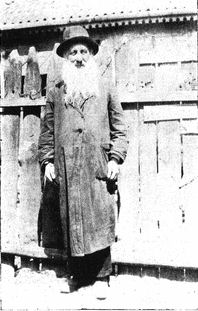
The Dayan, Shabtai (Shepsl) Kramarski
|
 |
|
A handsome Jewish man, with a ‘Herzl
beard’ and large, dreamy eyes. He came from a family
of merchants from the Prussian border. He studied at
yeshivas and clandestinely obtained a secular
education. He married Rachel, the granddaughter of Shia-‘Tzaleleh’s and Liebeh Rosenthal. Together with
his brother-in-law Zalman, they were the two dayanim
of the community, and at the disposal of the Rabbi.
He was a quiet and tranquil man from whom no one
ever heard a loud word, and he would never get mixed
up in municipal disputes. He would spend the entire
day studying the Torah beside his father-in-law’s
table. He was in harmony with his environment. He
enjoyed reading the books of the Enlightenment, and
as Dayan, you will understand, he did not do so
publicly. In later years, when his compensation
proved to be inadequate, he would learn the Gemara
with older students and even worked to prepare
younger students to be candidates for ordination.
He has children in Israel.
Reb Shepsl Kramarski, of
blessed memory. |
Rabbi Abraham Goronczyk (Goren) zts"l
|

Rabbi Abraham
Goronczyk-Goren, of blessed memory |
|
He was the son-in-law of the senior shokhet, R’
Nahum Lejzor Tziviak. He was born in Ruzhany, Poland in 1888 and
studied at the Greater Yeshiva of Makowa, later on at the
yeshiva for young people in Warsaw where R’ Abraham Gruzhinsky
was the headmaster. He received his ordination from R’ Chaim
[sic: Soloveitchik] Brisker.
He married at the age of twenty to the daughter of
the shokhet in Zambrow and became a Zambrow resident. At first,
he became a teacher of Gemara for older boys.
During the First World War, he committed himself to provide a substantial amount
of assistance to the homeless. Two years after the end of the
war, he and his family moved to Warsaw. Immediately after the
Balfour Declaration, he joined the ‘Jablon Chasidim’ to make
aliyah to the Land of Israel, and to build up the village of
‘Nakhalat Yaakov’ using their own personal energies, in the Jezereel Valley (today, it is called Kfar
Chasidim). |
He made aliyah in 1924, along with the first who
went, and he settled temporarily in Sheikh Avreik. A proposal was made to him to
become the local rabbi. He accepted it under the condition
that he not be paid any salary, and otherwise to count him as
another member of the community. He then proposed to give his
own hard pioneering work to drying out the swamps that were a
deterrent to the development of the village. With all the ardor
of a Chasidic and pioneering spirit, he personally drained about
seventeen kilometers of swamp. However, he fell sick from the tropical
malaria, and together with his family was compelled to move
to Jerusalem. At first, he became Headmaster of the ‘Torat
Chaim’ Yeshiva. After this, he took up residence in a park near Rehovot, because he was drawn to working the land and
did not
want to make his living from the study of Torah. During the
unrest of 1929 – he took up residence in Rehovot, and afterwards
returned to Jerusalem, and opened up an institute to prepare
students for rabbinical ordination. Rabbi Kook drew him close,
and in more or less all his correspondence, encouraged him and
praised him for his work and the tens of his students who
assumed rabbinical pulpits in the larger world.
In his final years, he dedicated himself to
rabbinic literature and prepared the book, ‘Explanations
Offered by the Vilna Gaon and the Rambam.’
He passed away after considerable suffering, on
14 Kislev 5720 (1959).
Rabbi Shlomo Goren, shlit'a Chief Rabbi of the IDF
|
He was born in Zambrow on 21 Shevat 5675, July
2, 1918 to his father, Rabbi Abraham Goronczyk-Goren (see
above), and was the grandson of the eldest and beloved shokhet,
R’ Nahum-Lejzor Tziviak. He came to Israel with his family in
1925 as an eight-year-old boy, first to ‘Kfar Chasidim,’ and
afterwards to Jerusalem, first at the ‘Etz Chaim’ Yeshiva, and
then finishing at the ‘Hebron’ Yeshiva, obtaining his rabbinical
ordination at the age of seventeen. He pursued Jewish studies at the
Jerusalem University. He pursued research in Talmudic studies,
and made significant contributions to research in the Jerusalem
Talmud, and at his initiative, a scientifically well-edited
version of the Jerusalem Talmud was published. He was the
recipient of the first ever Rabbi Kook Prize, awarded by the
Tel-Aviv municipal administration (1943). He served in the
‘Haganah’ and the Israeli military, and was a role model for
many young rabbis, and immediately upon the founding of the
Israeli Army he was nominated as the first Chief Rabbi, which
he occupies to this day with esteem and substance. Rabbi Goren
is the most serious candidate to become the Chief Rabbi of
Israel, after the passing of Rabbi Herzog z"l . |
|
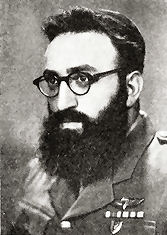
Rabbi Shlomo Goren
|
R’ Yudl Shokhet,
hi”d
By Joseph Yismakh
|
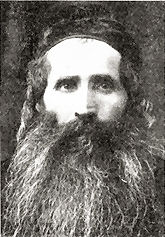
R’ Yudl shokhet
|
|
Let us first pen several lines to serve as a
memorial to a small corner of our little town which is our
house.
We were five neighbors. We were five working
neighbors, laborers, from whom light emanated, along with
tranquility and a love for work.
Yankl the Hat Maker with his five little
children, worked hard from before dawn to well after dusk, and
it was not only once that those little children went to bed
hungry. Nevertheless, he was a man you could count on. He always
worked while singing, singing while he worked – all manner of
folk songs, bits of cantorial liturgy, and he hoped for better
days.
Yaakov the Barrel Maker, a quiet and good Jewish
man, worked from dawn until late into the night. His wife, Chaya
Sarah, always helped the poor and was always at the ready to do
a favor for someone else. They had fine children, a son, Sholom,
and a daughter, Sarahcheh.
|
Moshe’l the Carpenter – This third neighbor had
golden hands. Much of the youth of Zambrow, among them not a few
who went on to become Chalutzim, were trained by him.
And another neighbor was David the Painter.
And the fifth neighbor was our family – Yudl the
Shokhet. His family name was Yismakh.
They were five residents there. They were all
exterminated....
However, let me stop here about one of these
neighbors, who was the closest and most beloved by me. This is
my father, Yudl the shokhet z"l.
In reality it would be appropriate to write
about all of those who were shokhets in Zambrow, who
made no small contribution to our town and were fine balebatim
and prominent members of the clergy, such as R’ Nahum Lejzor
Tziviak, the eldest of these shokhets among us, and
the grandfather of our military Chief Rabbi, Major General Rabbi
Shlomo Goren. After that came R’ Benjamin Shokhet (Rosenbaum).
And my father Yudl shokhet. Further, there are R’ Abraham Shmuel Fiontak, R’ Moshe Aharon Amsterdamsky, etc. To my sorrow, I
possess only minimal facts about them, and I can only pen a few
lines about my father.
As was the case in many small towns, my father
carried out those functions that had a connection to his
calling: a mohel, a leader of prayer services on the High Holy
Days, blowing the shofar and also a Torah reader. It is
understood that he did not receive any extra compensation for
doing these things. He did this out of a sense of duty, in
performing a mitzvah. Performing these mitzvot bound him and
tied him to the other clergy in the town, the Rabbi and the dayanim, the
gabbaim and the laity serving as parnass. My father
was a Chasid and worshiped at the Chasidic shtibl all year-round.
He made it his business to assure that his children abided by
Chasidic standards in dress and in habit. I recall the instance
when my brother Herschel z"l was studying at the yeshiva in
Lomza, at which time word reached us that he had begun to favor
the wearing of a white tie in the aristocratic fashion. This
irritated my father, who immediately traveled to Lomza to
determine if it was true and see if he could influence his son.
My father was one of the prominent balebatim in
the Chasidic shtibl. A long beard added to his resplendent
appearance. He was always an inspired teacher of the Chasidim. He
was versed in Chasidic lore, and was always telling historic
episodes of the Chasidic movement. Because of this, he was loved
everywhere and sought after. He was quite renown for his deft
touch in performing ritual circumcisions on newborn Jewish male
babies. He was well-versed in all the laws pertaining to
treiboring 65,
and the examination of slaughtered animals, and not only once
would he be called to Lomza and other cities to offer a ruling
on a difficult question in this area. He was an accomplished
leader of prayer services. The various houses of study competed
fiercely, with each other, to have him officiate as a cantor for
the High Holy Days, until a compromise was reached: the first
day of Rosh Hashanah – at the White Synagogue, and the second day
– in the Red one. In the latter, he also blew the shofar. On Yom
Kippur, he would conduct the Kol Nidre services, the Musaf and
Ne‘ila services. After Kol Nidre services on Yom Kippur [sic:
Eve], he would spend the entire night at the Chasidic shtibl,
standing up on his feet, reciting Tehillim, and learning until
the morning.
My mother, may she have a bright, illuminated
Garden of Eden, was always there to help him, being occupied
with receiving guests, and to be available to help out the
needy. If the need arose to spend the night and tend the
indigent sick, she would cook soups for them. When she would get
the ‘kashrut’ from the butchers, as was the town custom (the
viscera from a slaughtered animal), she would first send
packages to those who were keeping their needs secret, and
afterwards to the indigent Jewish women.
My father was a shokhet in Zambrow for a little
under sixty years. In his old age, he was bereft of energy.
After he married off his daughter Chaycheh to R’ Benjamin
Musicant – he permitted his son-in-law to come in and be his
assistant and to take over the business, with the consent of the
rabbi. My dear sister and her husband regrettably were killed
by the murdering Nazis, together with the Rabbi and other
balebatim. May their memory remain for the good.
R’ Berel Nigubcer zts"l
He was a formidable scholar with few who were in
the entire area like him. He was a self-effacing and honest man,
without any personal pride, and did not want to assume the
mantle of the rabbinate notwithstanding the fact that he was
repeatedly offered such. He was a scion of the family of R’ Leibeleh Kovner, and the root of his family was in Karlin, near
Pinsk, and he came to Zambrow from the village of Nigubcy. His
wife, Genendel, a Woman of Valor, ran a store of woven goods in
the city square, and he was the headmaster of the yeshiva at
Lodz. He invested the money he earned as a Rabbi in woven
goods in Lodz, and was an intermediator for his wife. He then
moved to
Zambrow and helped his wife in the business. He took part in
the religious life of the city, and was a confidante of the
Rabbi’s. He was fanatic in matters of faith, but also perceptive
and knew how to weigh a matter, and not to impose anything on
the community that would be unbearable. He was a joyous person,
and his dancing on Simchat Torah tugged at the sympathies of the
heart. He studied day and night, arising at one in the morning
in order to study Torah.
His oldest son, Yeshaya, was a scholar and a
rabbi in one of the towns of the Minsk Province, and was a
son-in-law to the Rabbi of Myszinowka. He immigrated to the
United States and was one of the leaders of the Rabbinical
Council, appointed to oversee ‘kashrut’ in a number of large
institutions that served food. He had the same insight as his
father and was active in Torah institutions.
Regarding his second son, Aharon-Leib and Yaakov – see further
on, in the list of the Berl Mark, regarding three families. In
his youth, R’ Yaakov was one of the heads of the Zionist
movement in Zambrow, and the first leader of Keren Kayemet, when
the ‘blue box’ reached the city. He is today in the United
States and is a secretary to the Rabbinical Council.
Rabbi Leib Rosing

R' Leibl Rosing z"l |
|
He was the son-in-law to Breineh-Pearl
Finkelstein, born in Russia. He studied at the
Slobodka Yeshiva, and received his rabbinic
ordination there. After his marriage he returned
there for further study, for some additional time.
His mother-in-law, Breineh-Pearl took great pride in
him: "I bought a ‘Torah scroll’ for my daughter,
because he is a holy man." And this nickname stayed
with him, He was one of the great Torah scholars in
the city, responding to the needs of the community,
establishing a Gemilut Chasadim organization. For
all his days, he was the right-hand man of the
Rabbi, and assisted him in leading the city in his
zealous struggles against outbreaks of opposition to
the faith and its tradition. He served as a member
of the Rabbinic Court of Justice, and because of
this he was elected to the municipal council. He was
beloved by all who knew him, for his honesty and the
goodness of his heart. In the ghetto – when the
Rabbi succumbed to weakness and exhaustion – he
served in his place as the rabbi of the community.
He was cremated in Auschwitz with his wife, Elkeh,
four of his daughters, and two sons-in-law. |
Cantors
|

|
|
We have no recollection of the first cantors of
the city. The older folks still speak about R’ Pinchas who was a
cantor and a shokhet. He came from Lithuania and was a good
friend to, or perhaps altogether, a son-in-law to R’ Israel Szkoder, the renown cantor in Lithuania. Also, his wife, Shifra,
was also musically talented. It is told that, the famous cantor,
Yossele Rosenblatt, was a student of her father, and being in
America at a very advanced age he would confer with her on
matters pertaining to cantorial liturgy.
R’ Pinchas died before his time. It
is told that he fell off the top seat in the bath
house, was injured and died. The balebatim took care
of the widow as follows: each week, she received a
portion of the animal fat that the butchers took out
of the slaughtered cattle. From this, she made a
living. At an advanced age she immigrated to
America, to her children and grandchildren.
One of her sons, Yitzhak (Itzik) was also a cantor.
The Cantor’s wife, Shifra, and her son, Yitzhak, the
Cantor.
|
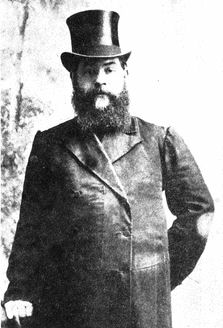
The second cantor in Zambrow, was R’ Shlomo
Wismonsky, from the Lithuanian shtetl of Dieveniskes66.
He was a handsome man, and well-dressed, who wore a
top hat and a black overcoat. He had a formal
musical education and could read musical notation.
He mastered all musical compositions and led a fine
choir that consisted of the best voices in the city.
In the first period, he would even import singers
from faraway places, and the city financed the
choir. He was a student of the cantorial school in
Czestochowa that was founded by Abraham-Ber Birnbaum.
The cantor was also a shokhet. Only the Rabbi was
concerned about his slaughtering, because he had
doubts about his piety. His permanent position was
in the White Bet HaMedrash, and he would from
time-to-time arrange a visit to the Red Bet
HaMedrash and to the synagogue. Many, especially
the craftsmen, would come to the Bet HaMedrash to
hear how he led prayers and to listen to his music.
Reb Shlomo Wismonski. |
|
 |
He lacked for food in his last years,
because the city had become so impoverished that, together
with his wife, he was compelled to take up doing business in
the marketplace. Later on, he went off to America, to his
children.
He was the last cantor of the city. For a short
time, Leib-Herschel, the youngest son of the melamed,
Israel-Chaim, served in a cantorial capacity. He was mainly a
hat maker, but he also had a pleasant tenor voice, and had a bit
of book-learning. Accordingly, he taught himself to be a
shokhet and had been a singer for a while in the cantor’s
choir, where he grasped the essence of what was needed, and
later on became a cantor somewhere in a small town not far from
Zambrow.
Preachers
As was the case in all towns, from time-to-time
an itinerant preacher [sic: a maggid] would come through and
preach. The rabbi would preach twice a year: on Shabbat HaGadol
and on Shabbat Shuva. On all other Sabbath days and quite often
in the hours between Mincha and Maariv services, itinerant
preachers, who would often go on foot from one location to the
next, would fill in with their own sermons. They would ascend
the pulpit and leave a collection plate at the door into which
each person would throw in a few kopecks. It was from these
funds that such itinerant preachers would derive the funds to
marry off daughters, build themselves a small house, and make a
living. They were called ‘Piekhotna Maggidim’ – those who were
pedestrians. A renown preacher would be invited to a repast with
the gabbai or the rabbi, where he was given some pointers on
what to include in his message. His words would be filled with
the legends of the Sages of old, parables, all delivered in a
sweet, traditional sing-song, which would leave an impression on
the city.
R’ Eliakim-Getzel Levitan

R’ Eliakim-Getzel Levitan |
|
For a time, Zambrow had its own stable of preachers
who were paid a weekly salary from the community
treasury. R’ Eliakim-Getzel was one of the most
renown of the preachers in all of Russia and Poland.
He was a powerful orator, a fanatic, who mesmerized
his listeners with his words. He would always use
his voice to thunder, with eyes closed, and accuse
the people of transgressions and malign intentions.
He came from Zaslow. His father was a renown teacher
of the Gemara in Kaidanov, at the courtyard of the
Rabbis, and later on in Stiubic. One of his students
is the current President of Israel, Mr. Zalman
Shazar, as he describes in his book, ‘The Star at
Dawn.’ The father exacted a vow from his son,
Eliakim-Getzel, that he would not become a preacher
because it would tear him away from study. However,
the Rabbis saw that the [sic: younger] generation
was falling away from Yiddishkeit and there was a
need for an effective preacher that will awaken the
flock to fulfillment of mitzvot, and to do good
deeds – and so, they sent him to the tzadik of
Grodno, R’ Nahumcheh, to annul the vow, and
Eliakim-Getzel became a maggid. |
When his father heard this, he said: ‘He will
now no longer be able to learn!’ In Zambrow, Eliakim-Getzel
founded a youth group, ‘Tiferet Bakhurim,’ where the young
workers and craftsmen could study Pentateuch with Rashi
commentary in the evening, recite psalms, and become ‘Jews.’
Because of his fanaticism and his sharp tongue, the less
observant element in the city hated him. During the dispute
between the two shokhets, he took the same side as
the Rabbi and excoriated those who ate the meat that came from
the second shokhet, saying that it is ‘as if they were eating
the flesh of swine.’ It was then conveyed to the provincial seat
in Lomza, that Eliakim-Getzel is awakening unrest in the city,
and is inciting the citizenry to conflict, one with another. The
chairman of the provincial government then insisted that the
Dozors of the city vote on this. A vote was taken, with the
majority finding against the maggid. Accordingly, he was
compelled to leave Zambrow. On his last Sabbath, he saw fit to
appear and curse the city: ‘A fire burns, and the city will be
consumed by it.’ And indeed, shortly thereafter, in the year
1895, the city burned down.
As previously indicated, he was a great orator
and had great influence among the uneducated masses. He would
move men and women to tears, speaking of sins and about the
punishment that awaited sinners in Hell. Later on, he was the
maggid of Bialystok, Minsk, etc., and his name was famous
throughout all of Russia and Poland.
In the year 1908, his son, a reverend from
America, gave a sermon in the White Bet HaMedrash, not at all
like the father. He was dressed in the short [sic: modern]
style, and spoke like a modern orator, not using his father’s
sing-song style, and was a Zionist... accordingly, the listeners
in the White Bet HaMedrash were disappointed.
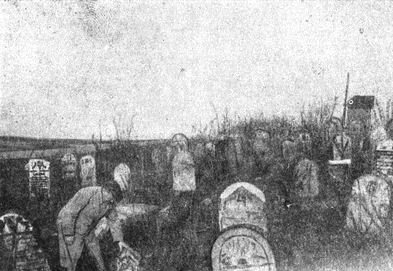
The ruins of he cemetery in Zambrow
R’ Akiva Rabinovich (Poltaver)
R’ Akiva was a son-in-law of R’ Elyeh Rosenberg.
He was raised in Piotnica, where his father was the rabbi.
However, he would often come to Zambrow, where he loved to
preach.
When, later on, he became the rabbi in Piotnica,
after his father had passed away, he joined the Zionist movement
and was one of the first rabbis who was a ‘Lover of Zion.’
Thanks to the initiative of the Rabbi of Bialystok, R’ Shmuel
Mohilever, Akiva became the Rabbi of Poltava.
Because of an incident, in which he was
insulted, he became a great opponent of Zionism: at a
‘Hovevei-Zion’ conference in Warsaw, and a Rabbi Rabinovich was
elected President. He thought that they meant it was him, and
when he saw that he had made a mistake, he was deeply offended
and became a protagonist. Once, after the second Zionist
Congress, he was on a visit to Zambrow at his father-in-law
Chona Tanenbaum, and appeared according to his father-in-law
to manifest a desire to preach. The Zionists then organized
themselves and would not permit this under any circumstances,
because he would speak out against Zionism. This persisted,
until he promised that he would not speak out against Zionism
and the Land of Israel. A tumult ensued: Well, (they said), you
mean that you won’t? He answered: Let me give you a parable: a
person had to go to Lomza. He encounters a horse on the way. So
he says: Little horse, little horse, take me to Lomza! So the
horse replies: But I am going in the opposite direction, to Tyszowce! So he says: It doesn’t matter, take me on board, and I
will ride to Tyszowce. When he already was sitting on the horse,
he pulled on the reins, and turned the horse around to Lomza,
where he wanted to go... the analogy is: if I am already
standing on the bimah, I can say what I please... and said: I
will offer you yet another parable: a king had a beautiful
daughter, and God forbid, not on you, she fell ill. No doctor or
professor was able to save her. A pauper came along. dressed in
torn clothing, and offered that he could save the sick princess.
The king saw that he had nothing to lose, because his daughter
was in dire straits – so he agreed to let the pauper try and
heal his daughter. When the sick princess saw the pauper
standing beside her bed, she understood how great the misfortune
was, and how dangerously ill she was, and that it was all the
same as far as her father was concerned... the same is true with
the sick ‘Mother, Zion.:’, when she sees who it is that is
coming to cure her of her illness, she weeps and says: 'Zion-
Zion, our Holy Land, how great is your misfortune, who will heal
you... these Zionists?'... You can appreciate that Akiva
Poltaver never again preached in Zambrow, even though he had
friends here, and was later on to become famous as the editor of
the anti-Zionist journal, ‘HaPeless.’ R’ Alter Maggid (R’ Moshe
Zalman Urwicz) (son-in-law of the Lady Dyer) Alter the Maggid,
or as he was called, the ‘Son-in-Law of the Lady Dyer,’ because
he married the widow’s daughter, from the house of Wierzba. He
was a comely Jewish man, with a wide black beard, attractive
blue eyes, and would always dress neatly, wearing a wide
Chasidic cap. He would speak softly, smilingly, exhibiting no
sternness, even to those who opposed him, and would even try to
be helpful in responding to those who abjured their faith.
Nevertheless, he was a zealot, and he did what the Rabbi
directed him to do, in fighting every new thing that intruded on
Jewish life. He would weave in all of the shortcomings of life
in the city into his sermons, and he would severely
reprove all those who did not adhere to the old ways. He
abhorred the Zionists whom he would call ‘Tzio-nisht-en67.’
He could not countenance the socialists, and fought against the
modern school for children, the parties, the library, etc.
His faithful listeners, and students were the
simple people, workers, craftsmen, and small-scale businessmen.
The more urbane balebatim and youth would fight back against his
preaching – but always respected him personally because of his
good character. When the economic conditions worsened – the
Zambrow Society in America assumed the burden of supporting him.
In about 1924, he came to New York. All of his adherents
escorted him with tears in their eyes, and said their goodbyes
to him. Zambrow, they said, will never again see such a maggid....
(see above page 244).
In America, as well, he was a maggid. He would
‘preach’ in the other synagogues, but his chief means of support
was from the Zambrow society, which greatly respected him. Later
on, he became a rabbi in the 'United Zembrover-Jedwabner
Synagogue.’ He mellowed in America, and understood that it was
necessary to go with the flow rather than against it, yet he
felt alone here and defeated. He no longer had his one-time
ambience, his learning coterie, and the observant Jews.
He passed away on 9 Shevat 5713 (1953) and the entire [sic:
Zambrow] society attended his funeral, according him this last
final measure of respect.
A very substantial memorial service was also arranged by the
society on February 21, and he was eulogized by Rabbi Yaakov
Karlinsky and others. In the invitation to the service, it was
written: "He was beloved by all for his good Jewish heart."
Shammai Lejzor
He was a big-boned strong man, and good-nature.
He was a scholar, and God-fearing, and he would derive his
sustenance from his small bakery, where his wife and daughters
would bake bread, challahs, and put up cholent [sic: on Friday
nights, to be kept warm for the Saturday main meal].
Shammai-Lejzor would assist in this, and quite often engage in
the putting in and taking out the bread from the oven.
What was special, however, is that he was something of a
preacher. He would travel among the various cities and towns,
collecting money for the ‘kessel kosher,’ this being the kitchen
for the Jewish soldiers who did not want to eat from the
‘unkosher pot,’ as it were. He would hold forth on the virtues
and the great mitzvah of observing the rules for a kosher
kitchen. When he would stay in Zambrow, and he would study a
page of the Gemara with the rabbi. Occasionally, he would
assemble a coterie of young people and study with them. After
the war, when Poland became independent, he became an emissary,
and he would travel to raise money for the yeshiva. He never
preached in
Zambrow itself.
He was a man of the people, mixing easily with
the erudite and the simple folk. He two sons-in-law, Mones
Burakewicz and Yankl Provda, were active ‘strikers’ in the year
1905.
Chaim Velvel Pav
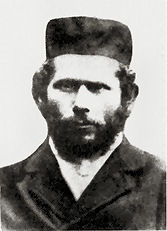
R’ Chaim Velvel Pav |
|
He was a special kind of a preacher
to the masses. He was really a man of the people,
living modestly, as if he were a lamed-vovnik, and
would comment in a rather soft manner with regard to
those who did not conduct themselves in a manner
that was appropriate.
He was born in Ostrow Mazowiecka,
and took up residence in Jablonka, and as a young
man, he studied in the yeshivas and knew how to
learn well. However, he did not want to derive his
sustenance from Torah study, and took to a trade, as
a hat maker, working very hard and often dozing off
while at work because late into the night he would
sit and be studying from the Gemara. On one
occasion, a large fire broke out in the shtetl. His
house and all of his possessions were consumed. When
he went up into the attic to rescue his furs, the
fire enveloped the ladder. It was necessary for him
to jump down, as a result of which he was all banged
up and his face was burned. The burn scars remained
with him for the rest of his life.
|
Without a groschen to his name, and without
bread for his children, he came to Zambrow but was no longer
able to practice his trade. He took the advice his good friend,
Alter the Maggid, and mastered a number of sermons because he
knew how to learn, and he became a Maggid himself. He would
travel and go from town to town, and always obtained a couple of
groschen for his sermon. He would never ‘orate’ in Zambrow. When
his children gave him some help, and his son, R’ Louis Pav sent
him the first twenty-five dollars from America, – Chaim Velvel
immediately abandoned his oratory, and again began to live off
of his own work: He leased an orchard with a partner, and from
this, more or less, he made a living. He would lie in the
orchard for the entire summer, with his Gemara in his hand.
During the German Occupation of the First World
War, he went to break stones to avoid having to approach people
for charity. Everyone respected him, as a decent and good Jewish
man. Shortly before the Second World War, in the year 1938, he
died in Zambrow and was privileged to be interred in the Holy
Land.
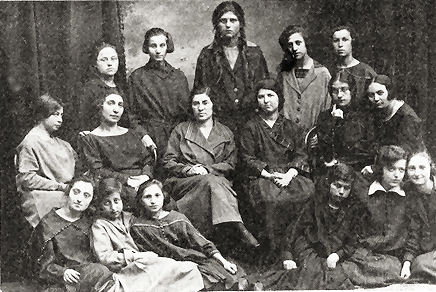
Page 294: A Group of Teachers and Pupils
Women of Scholarly Repute
Zambrow Women Who Possessed Scholarly Expertise in Depth
In the past couple of decades, Jewish daughters,
in Zambrow studied: Pentateuch, Hebrew, Yiddish, Russian,
Polish, and learned to write ‘Shura Gruss’, with the more
skilled among them taught the writing of addresses in English,
in the event that they should marry husbands that would emigrate
to America, so they not be disadvantaged, and be able to write
out a mailing address without recourse to an ‘expert.’ They were
taught by special teachers, such as the ‘Fly-Doctor’ Nosskeh the
Melamed, Bercheh the Melamed, etc. Such [sic: girl pupils] sat
on separate benches, and were not intermixed with the boys.
Later on, the ‘Szkola’ came along: [with them] the
Russian-Yiddish teachers like Swiersky, Szczynko, Friedberg,
Lev, and others, who would teach girls mostly, in the Russian
language. Afterwards, close to the time of the First World War,
and later – a modernized [sic: reformed] school came along, and
the schools of Fyvel Zukrowicz, Zerakh Kagan, [Yaakov] Tobiasz,
the Yiddish school of N. Smoliar, Y. Domb, Lola Gordon, the
Polish Volksschule and others. It was here, that the Jewish
daughters obtained their education.
However, in the days of yore, until the
beginning of the twentieth century girls were not educated.
Accordingly, it was by a miracle that there developed Jewish
women who were righteous, who took upon themselves as a sacred
mission, to teach girls ‘Ivri,’ to read the ‘Teitch-Chumash' 68,
teach then how to properly kosher meat, to be able to recite a
prayer of request to the Almighty, and to be able to participate
in prayer at the women’s synagogue.
I am desirous of writing about a number of these ‘educated
women,’ to the extent that I can recall them, now nearly sixty
years ago.
1. Chashkeh the Lady Carpenter
The first among these women was Chashkeh, the wife of Moshe’l
the Carpenter, who was a tiny shrunken old Jewish lady, with
weak eyes (who became blind in her old age). She knew how to
read and write, and how to recite incantations to ward off the
‘evil eye.’ She knew all of the prayers of beseeching the
Almighty by heart, as well as all the weekly Torah portions – as
they appeared in the Teitch-Chumash. She would take no fee from
poor girls whom she taught. Her home was in the horse market, at
the adjacent corner of the Lomza Street. In the city, she was
characterized as a Righteous Woman. From time-to-time, she would
walk through the streets, visiting all of the houses with a red
handkerchief in her hand – to collect small coins for charity,
and the mitzvah of dowering a bride who might be poor and
orphaned, or for widows, for a woman whose husband had abandoned
her to go to America, or for just plain people in need – there
was Chashkeh. She was always respected and donations were given
gracefully.
If it happened that a woman bore a child with a great deal of
difficulty, which compelled everyone to engage in the ritual of
‘tearing open the graves,’ that is to tear open the Holy Ark,
and to compel the Master of the Universe – to bring this sick
person back to health, and if it was necessary to inform a young
woman of the
rules pertaining to how she must now conduct her ablutions, etc.
– one came to Chashkeh. She knew everything. Today, to conjure a
‘good eye,’ or to recite complete esoteric passages, and to then
spit seven times, in order to drive a disease away – this was
Chaskeh.
In her old age, she located a virtuous young
girl, who was an eldest daughter, and the eldest granddaughter
of an eldest daughter, to whom she transmitted her secret
incantations, teaching her all the right words to say, to thwart
the ‘Evil Eye,’ and other such stratagems.
2. Fat Baylah
‘Die Grobbeh Bayl’tseh,’ as she was called [sic: in Yiddish] ,
was the director of the girl’s division of the cheders of Israel
Chaim Fleischer – or as he was called: ‘Srol Chaim of the big
backside’ He was my first good rebbe, who taught me Hebrew, and
I have much to be thankful to him, for my understanding of
Yiddishkeit. I recall: At noontime, the girls would start to
arrive in cheders, mostly six to nine years of age (I was, at
that time, barely five years old). They would mill around the
door, helping the Rebbetzin to peel potatoes, and together
carrying out the scoop pail full of peelings and pouring it out
onto the side street that was behind the burned-down synagogue,
helping to wash groats, making a herring, etc., until a tall
stout Jewish lady would walk in, with a stern smile on her lips,
her head covered in a colored babushka, girded around with a
broad blue-checkered apron, over a brown cotton and linen or
velvet skirt, with a green-striped and a chintz-flowered little
blouse. She would exclaim: ‘Children, go grab a bite!’ and then
nothing would avail. R’ Israel Chaim was compelled to leave the
student in the middle of poring over the siddur, smooth out his
bunched-up fringed garment, scratch his beard on the right and
left, take a deeply inhaled pinch of snuff, look at the side of
stout Bayl’tseh and say: ‘Indeed, go grab a bite!”
When the young boys left, came the time for the girls. Israel
Chaim would then sit down to eat some radishes with sour cream,
a green scallion, with bread dipped in salt. A plate of potatoes
and kasha – with milk, and would occasionally wash this down
with red borscht, together with the keg, or with a green
shchav, whitened wither with the yolk or the white of an
egg, and in the meantime, Baylah would don her metal-rimmed
glasses, and study Hebrew with the girls, holding a pointer in
her hand. Later on, she would teach them how to recite a
blessing. In taking the ritual portion of challah in preparing
to bake challahs for the Sabbath, or bread, lighting candles –
with the movement of her hands, showed them how to shut their
eyes, and how the blessing was to be recited, etc. Not only once
was she compelled to shoo me away: Go home, little boy, it is
not nice to stare at girls while they are learning...
The Rebbe would look askance at her – that she should take
account of who I was: Nachman-Yankl’s grandson, and a son of the
teacher...
This was something of an affront to the Rebbe’s sister, or
sister-in-law, because she would act as if she were in her own
home. The girls would bring money for the new month, and
occasionally a special gift: a rogovka, a piece of
white-blue soap, sometimes small red turnips, or sometimes green
‘tshiftchukh.’
On the Sabbath, and on Festival holidays, especially on the High
Holy Days – she served as a ‘zogerkeh’ in the Women’s
synagogue: with a clutch of women around her, with the ‘Korban-
Mincha’ prayer books in hand, or the Shas supplications,
repeating after her, word for word, using her melody and
intonation. Mend’keh, Israel Shia-Tsale’leh’s and other wags,
would mimic her and tell jokes about the women who would recite
after her, who didn’t know what they were saying, and often
making errors that were laughable. Yet, this is the way it was
in many towns.
3. Henny Itkeh
Henny Itkeh was a widow, the mother of
Abraham-Herschel and Shlomo Burakewicz (the father of Shmuel-Lejzor’s
son-in-law, the mailman during the German Occupation of the
First World War). She would read the portion of the week in
front of the women every Saturday, after the noon hour, from
Tzena u’Re’ena, and would add her own commentaries and stories
that related to the portion. She was called ‘The Lady Rabbi.’ It
was told that she possessed the capacity for study just like a
man, and had at one time studied the Gemara – something that, at
that time was barely believable.... she would take no money for
her learning with the women, so the women would send her gifts:
a liver, a fish, a challah, eggs and honey for the High Holy
Days. She was a ‘reciter’ in the White Bet HaMedrash. I remember
how the people joked about her: ‘And Noah was a righteous man
for his generations,’ she would translate as ‘Noah was an
observant man (frumer mann) in his generation.’ The naive
women would repeat, and say ‘fur mann’ instead of ‘frumer
mann’[sic: a wagon driver] with instead of in, his ‘tzoris’
‘instead of ‘doyress.’
4. Bluma the Blind Lady
I did not know her. She lived at the Koszaren
and was blind in one eye, and she was a teacher. She was a tall
Jewish lady, and healthy. She would teach girls the aleph-bet.
She was a ‘reciter’ in the synagogue of the Chevra Shas.
5. Pesha Golombeck
She was the wife of Berl Velvel and the
daughter-in-law of Manusz Golombeck, was totally fluent in the
Mahzor, and knew all of the prayers of beseeching by heart. It
was told that she even created her own prayers of beseeching. On
Yom Kippur Eve, she would assemble the women about her, many who
were indigent, in the Red Bet HaMedrash, and read the prayers to
them. She would also got to the homes of the poor to read
confession with the sick, and to give them courage and not to be
afraid: ‘One does not die from making confession,’ – [ she would
say], and the righteous recite such a confession every night
before they go to sleep. She would visit the poor women who lay
ill – recite Tehilim and when necessary: would recite
confession. ‘One does not die from reciting confession’ – she
would raise the spirits of dying and bewildered women, the
righteous recite confession every day... The time when she shone
was during the High Holy Days. The prayer hall of the Red Bet
HaMedrash would be packed with women. They came to pour out
their hearts before the Master of the Universe, and their
command of Hebrew is tenuous, and they can’t follow, repeating
after the Hazzan... so she would sit herself on an elevated
stool, and direct the tens of women: now, my dear children, show
your hearts, we are getting ready to say u’Nesaneh Tokef...’ You
understand, of course, that she took no remuneration for this.
6. My Grandmother, Rivka Gittl
My grandmother was also an ‘educated woman’
according to what that meant in those days. She had her own
separate shelf with her books: a Teitch-Chumash, with many
illustrations, a ‘Korban- Mincha’ siddur, a book of prayers for
beseeching, Mahzors containing translations from Hebrew [sic:
into Yiddish], booklets containing blessings for after meals,
books on Mussar in Yiddish, a calendar with candlelighting
times, a ‘Ma’aneh Lashon,’ etc. Women would be constantly coming
to her with questions about the appropriate action and what
should be prepared for the ‘First Seder,’ and what for the
‘Other Seder,’ what should be included in the cholent for
‘Shabbat Shira,’ or ‘Shabbat HaGadol,’ which may have come out
on the eve of Passover itself. I remember very well, her
‘cultural work’ among the women, after the Saturday afternoon
nap, during the day, and especially at Tisha b’Av at night. In
the summer months, on Saturday after the nap, the lady neighbors
would come to my grandmother, her daughter, and daughter-in-law,
to recite ‘Perek 69’
with Yiddish translation from the Hebrew, and to read the weekly
portion in Tzena u’Re’ena. My grandmother would serve Jalowcowa
beer as a refreshment, which she would make herself, or with a
drink of cold water, which one of her sons, or grandsons would
bring from the brook. An elderly woman would come to my
grandmother every Friday, would smear her head full of a mild
soap, and shave her entire head with a straight razor.
Immediately afterwards, she would don her Sabbath wig, woven
from nice black hair, adorned with pins, that were decorated
with colored beads and flowers. Dressed in a black silk dress,
with jewelry around her neck, on her breast and hands (part of
her gold jewelry is under my care to this day), with a thin,
woven Turkish shawl thrown about her shoulders, she would sit,
with her feet on a footstool, and read to the women – from the
portion of the week, or the appropriate section of Perek for
that Sabbath.
On the night of Tisha b’Av, she ‘observed mourning the
destruction [of the Temple]:’ Sitting on kerchiefs, spread out
on the floor, women would listen to how my grandmother would
read from The Book of Lamentations in her Teitch-Chumash. In the
house – it was dark, except by my grandmother’s side there stood
a brass candlestick (the Sabbath candlesticks were silver) with
a large candle in it. My grandmother is reading, and the women
weep and wail over the destruction [of the Temple]...
Once, on Shabbat Shuva,70
after reading the Haftorah in Yiddish, my grandmother said a few
words about the Day of Judgment which was drawing nigh, and the
need to engage in repentance. Suddenly, she sang out:
"HaYom, HaYom HaYom71,
vos helft dir dyn gevayn, Today, today, today, what good is your
weeping, Az der Boyreh Oylem ruft, mooz men dokh gayn... If the
Creator of the World beckons, one must go..."
This ditty, with its melody, echoes in my ears
to this day....
7. Chaya Zuckrowicz
She was the widow of Nahum-Leib Zukrowicz, who
was the uncle of Yankl and Meir Zukrowicz, and father to the
teacher Fyvel Zukrowicz. She was a clever, witty woman, who
would make sport of the balebatim and unlettered people who
tried to pass themselves off as scholars. On the little bridge
before nightfall on Friday, she would tell stories abut the
righteous, and by contrast about devils and spirits. She would
serve as the master of ceremonies at large weddings. No one made
a move without her. She would put together the menu, and where
to have the reception, where the groom should stand, and where
the bride should sit during the badeken, etc. She knew all the
little details and would also serve as a reciter in the women’s
synagogue of the White Bet HaMedrash. She would laugh at the
women who had no facility with Hebrew, and all they could do was
repeat.
She was an alert woman, loving to tell stories
and jokes, and would prepare menus for lavish weddings, and
would recite prayers and beseeching verses before the women. Not
once would I subsequently overhear her joking with a Polish
woman about how she would deliberately make errors and switch
around lines in the prayer text. She once told the story of how
a certain woman, wanting to demonstrate her fluency in prayer in
reciting before the women, began the introduction to the ‘Shema’
as ‘El Melekh...’ and continued with ‘Katckeh Drelekh’ – which
is nothing more than a child’s song.
8. Women Who Received a Pension
Every Thursday, Shifra, the elderly wife of the
Hazzan, would receive the ‘leavings’ from the slaughter, a
portion of the ??? fat – as a pension, because her husband,
Pinchas the Hazzan and shokhet, died before his time. She would
bring this fat to her granddaughter, ‘Chana the Busy Body’ –
Broder, and both of them would cut up onions, melt the fat [mix
it together,] and sell it. She made a living from this, because
the community was not able to pay her a special pension (see
above p. 286).
A second one was Malkunyeh. She was a heavy-set
woman, with perpetually red and sickly eyes. Her husband was
‘Abraham Berl Klinn’, the village idiot. She was well-regarded
by the women, a member of the Chevra Kadisha, and at one time,
she was a functionary at the mikvah. She, or her former husband,
had some kind of relationship with the butchers, and they would
always give her the ???? at no cost, or at a nominally low
price. So she would go to the river to wash the ??? and
temporarily dirty up all of the water, The boys, who would go
there to swim, would curse her for this, and sing after her:
Malkunyeh with the lungs jumped into the garden...
One time, when I was learning at Berszteh, who
had his cheders near Yossl the oil maker at the edge of the
river, we -planned to accost her, and insist that she wash the
??? at the pond near Pfeiffer’s burned out-mill. Well, Berszteh
the teacher butted in, and it became evident that she was a
relative of his, his aunt’s daughter, or a sister-in-law...
9. Malka Tzimbel
She was a fiery sort of Jewish woman, whose
husband was a porter for the Rothberg family, if I am not
mistaken. She was a happy sort of woman, and would cheer up the
men and women at weddings and other happy occasions, singing
folk songs, reciting jokes, etc. It was told that once, when she
was younger, she would dance at weddings and sing with a cymbal
in hand, like Miriam the Prophetess had done when the children
of Israel had crossed the Red Sea, and for this reason she was
called Malka ‘Tzimbel.’ She had talented sons, one like the
other: Elyeh, Abraham’keh and Itzl. Abraham’keh was the Zambrow
songbird, singing for the Hazzan, and would sing beautifully
along the promenade on the evenings when folk songs were sung.
10. Shayna Mindl
She was the oldest daughter-in-law of Israel
David Shammes. Her husband, Herschel, was a Jewish man of
scholarly repute. He went off to America and caused his wife to
wait for a long number of years. Together with her gifted
daughter, Chana-Gittl (her husband was also in America), she
made a living by selling illegal whiskey (okwiat). After prayers
(she lived across the street from the synagogue), the Jews would
stop in at her place for a quick snort and a bite of egg kichel
or a piece of sugar. Not only once did the police come to
perform a search to find whiskey. However, she was a very clever woman (she came from Goworowo), and when the police would
discover that she had a flask of liquor, she would pour out
large glasses of the stuff, set it up in front of these officers
and say: good, first drink, and freshen yourselves up,
afterwards, you can carry out your procedures.... and so they
would drink themselves full, wipe off their moustaches, and go
away.
On one occasion, a new, and unfamiliar police
guard came along, so she grabbed the flask of whiskey and said:
see what is here – this is after all only water – and poured it
all out right in front of his eyes... and so he became verbally
abusive for these ‘Jew tricks’ and was unable to do anything...
She was a wit, and would tell spicy jokes for men from time to
time, and would order the children to leave in those cases. She
read ‘modern-day books’ and was thoroughly conversant with the
novels of Shomer and Blastein, always being cheerful and full
of humor.
During Passover, Jewish soldiers would always
get together and eat a good holiday meal at her place, and the
house would be gay, and people from all over the city would come
to stand under the windows, to hear the singing and small talk.
She died in America.
Scribes
By Eliezer Pav
Zambrow also had its own scribes. The creation
of a Torah scroll was usually done in some other large city.
However, smaller tasks, such as Torah scroll repair, preparing a
set of phylacteries, a mezuzah – this would be done locally in
the city here. We had an elderly scribe, a diminutive Jewish man
– Zelikl the Scribe. He derived insufficient income from this,
and accordingly sought a different craft: he would make cotton
blankets, together with his wife. He had an only son – Isaac who
was called Meizl. He wasn’t very capable, with crooked feet, and
he was a conversation piece in the city.
Fishl was a second scribe. He was somewhat hard
of hearing, middling height and broad-boned. He was a good
scribe and worked out the formats personally: He bought leather
from a kosher animal, personally scratched off the fur,
straightened it, whitened it and powdered it, and afterwards
wrote on it.
When economic conditions worsened, he opened a
private little library and would deal in modern Hebrew and
Yiddish books. He would astonish everyone with his knowledge of
books and their authors. One could get a good book to read from
him at a cost of a kopeck a week, and he would always consult
with Benjamin Cohen, who was the principal representative of the
books put out by ‘Toshia.’
R’ Fishl was the last scribe in the city. After
him, no scribe was able to find a way to make a living in the
city. Accordingly, mezuzahs, phylacteries, and handwritten Torah
scrolls were purchased from outside sources...
Education & Culture

The Long-Serving Rebbe and Teacher, Bercheh Sokol,
with Pupils
Yeshiva
Zambrow supported a yeshiva for all its years.
This means that it was concerned with ensuring that older boys
who wish to continue their studies beyond cheders wo0uld be
afforded the opportunity to sit and learn. Good Jews, for the
most part, craftsmen, would see to it that all the yeshiva boys
from outside of the city would be allocated ‘days’ to take their
meals, free lodging, and they also looked after ensuring that
the various headmasters received their wages. When the Lomza
Yeshiva was founded as an institute of higher learning for
Talmud, its leadership decided that it would found small
yeshivas in the smaller towns such as Makowa, Zambrow, Ostrowa,
Stawysk, etc. – that would prepare students for the more
advanced yeshiva in Lomza. The yeshiva at Zambrow was counted as
one of the best, and even received support from Lomza.
After the fire, R’ Yehuda Adaszko was Headmaster
(he was killed by a lightning bolt), and then R’ Joshua
Gorzholczany. The Rabbi directed the yeshiva and concerned
himself for its survival, and under him – the entire city...
among the first of the inspectors who provided oversight of the
curriculum, and how the young students were being directed, was
R’ Mishe-Michael, the son-in-law of Shmuel the Butcher: a tall
and stern Jewish man, who limped on one foot, and before whose
walking stick, the young little boys cringed. He would also run
a lesson. A second such inspector was R’ Moshe Yaakov Slodek
from Wysoko, etc.
In the year 1916, during the German Occupation,
the Rabbi’s son-in-law, R’ Aharon Yaakov Klepfish, returned from
Slonim, where, for a period of time he had served as a yeshiva
headmaster. Together with his brother-in-law, R’ Chaim-David, he
planned to open a large yeshiva and make Zambrow a center for
Torah study. At that time, the Lomza Yeshiva was in distress.
The leader, R’ Lejzor, and his sons-in-law, went off to Russia
by way of Semiatice and remained there. The sources of money
were tapped out, and the severe years of hunger tore away many
young boys from pursuing learning. It would be somewhat easier
to support a yeshiva in a small shtetl. And indeed, in Radun,
Volozhin, Novardok, Telz – you had small towns with large
yeshivas. As an inspector, they attracted to themselves the son
of the inspector of the Slobodka Yeshiva, R’ Shmuel Finkel, who
by chance, happened to be located in Lomza. Accordingly, Zambrow
became a locus for Torah study. Apart from the children of
Zambrow, talented children from all of the surrounding towns
came, even from [as far away as] Bialystok, and among them, a
few scholars who could not travel back to the Lithuanian
yeshivas. In time, additional resources arrived, such as the
son-in-law of the Vizner Rabbi, Rabbi R’ Yehuda. A scholar from
Bialystok, R’ Eisenstadt, and others. All of the Zambrow
balebatim and craftsmen donated ‘days’ and also paid in a weekly
stipend. R’ Shammai-Lejzor became an emissary and traveled to
gather funds for the yeshiva from other cities.
During the time of Polish sovereignty, the
yeshiva again was sapped of its strength: part of the students
went off to the military, or had to emigrate, R’ Aharon-Yaakov
became the Rabbi in Sniadowo, R’ Chaim-David married the
daughter of the Rabbi of Lomza, and the yeshiva nearly fell
apart.
The Rabbi and the balebatim, such as Meir
Zukrowicz, Abraham Shlomo Dzenchil, Leibl Rosing, etc., did not
rest, and they restored a small yeshiva. The Rabbi and R’ Joshua
gave lessons, and R’ Yankl-David the Shoemaker, the son of the
shoemaker from Gosz, stood at the head of those who looked after
arranging ‘days’ and lodging for the young scholars. The yeshiva
existed until the city went under (see above, page 218).
Cheders
As was the case in all other small towns, there
existed in Zambrow three types of schools for children:
1. The cheders – Run by melamdim.
2. The cheders Metukan – The reformed cheders, which served as a
transition to the third sort of educational institution. 3. The
school.
Of the chederss, let us here recollect three of
the outstanding chederss which were close to me: [sic: those of]
Bercheh Sokol, Fishl Danielewicz, and Joshua Gorzholczany.
There were many melamdim in the shtetl whose
names continue to reverberate in my ear to this day, such as
Chaim Reuven the elementary level teacher, Israel Chaim
Fleischer with his son, Pesach the Melamed, Elyeh the Melamed,
Shimon the Melamed, Pinia, Shepsl Kwiatek, Motya’s son-in-law –
Mendl Alsheh, ‘Tzenerl’ the Melamed, Abba-Leib, Chaim Melamed,
Avi-Ezer, Lipman, Fyvel Branever. Itzeleh Abraham’l the Melamed
from Kuliaw, the one from Jablonka, Khamiszoszka’s son-in-law,
Herschel Kooker, Chaim Hirsch Tzinowicz (a Gemara melamed),
Shlomo Tzinowicz – his son. Meir Fyvel, Abraham Moshe, and
others.
However, the previously mentioned were the best
in the city.
|
Bercheh Sokol, a short
person with a broad back, was the son of a prominent
Jewish man, who held the office of the gentry house,
and was a Kohen, and because of this was called ‘The
High Priest.’ Bercheh was a smart man, and a first
class pedagogue, even though he would hit the
children (he was a Kohen, with a bad temper...). He
always had a large cheders, of up to sixty children
of various ages. He would divide them up so that the
older and better students would learn with the
younger ones, and quiz them, so that Bercheh himself
would just have to maintain control and oversight.
|
|
 |
Invitation to the Memorial Meeting for the Late R’
Bercheh Sokol |
These ‘assistants’ would keep track of
which lines the students did not know, on a note, which they
would turn over to Bercheh, and afterwards he would quiz them on
exactly those sentences. Despite the fact that he did not teach
Hebrew in Hebrew (Ivrit b’Ivrit), his students knew the Tanakh
and Hebrew well. They wrote compositions in Hebrew,
descriptions, letters, etc. He subscribed to a weekly paper: ‘Olam
Katan,’ and afterward ‘HaChaim v’HaTeva,’ ‘Perakhim,’ and
others. He organized a small library in the cheders, and every
Friday each student would receive a book to read at home. He
also taught songs and sports. At his place, young boys and girls
studied together. In the summertime, the children would enjoy
the benefit of fresh air, by going outside to study or taking a
stroll in the forest, and not only on Lag B’Omer. He would go
with the children to swim in the river, would do gymnastics,
etc. Religious parents would not send their children to be
taught by him.
Bercheh was not any kind of observant
individual, and would involve himself in partisan politics and
was a socialist, who once was a Bundist,’ and in his last years
a member of ‘Poaeli Zion.’ His student knew the Poaeli Zion
‘oath’ by heart, in both Yiddish and Hebrew. As far back as
1905, he had organized evening courses for male and female
working people, and was a Yiddishist more than an Hebraist. He
was a melamed for over thirty years, until he went over to
America, to his children: Ruvkeh, Myshkeh, Shimon, and a
daughter, approximately in the year 1918. There, his children
set him up in an old age home, and he lived there to the
marvelous old age of one hundred. He passed away in 1961, and
his New York landsleit accorded him great honor.
Fishl the Melamed
|
Fishl the Melamed came from Sniadowo, married
Zisl in Zambrow, who was a sister of Yirmiyahu Syeta. He was a
good Hebraist and earned a reputation as an outstanding
pedagogue. He taught Tanakh and Gemara. He taught a great deal
of Hebrew and loved to read every day in class, in front of
the students, chapters from the Hebrew literature. He read
stories from ‘Memories of the House of David,’ and would excite
the imagination of the students, and encourage them to do
independent reading. He taught the laws and customs from the
abridged ‘Shulkhan Arukh’ for students, prepared by Rabbi Y. B.
Lavner (the editor of ‘Perakhim’ and the editor of the book ‘All
the Folklore of Israel.’). He was disinclined to take on many
students, as did Bercheh Sokol. He had two classes, which he
would integrate frequently. He gave his students a very
impressive national education. He was a genteel man, of mild
manner, a Zionist and a lover of the Hebrew language.
|
|
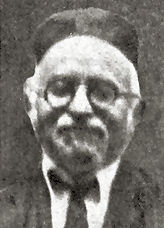 |
He was one of the first Zionists of the shtetl.
When Keren Kayemet L’Israel was established in 1902, and before
the blue boxes reached Zambrow – Fishl the Melamed pre-empted
the process, and together with is friend and comrade Rabbi
Israel Levinsky ordered one hundred boxes from Leibusz the
metalworker on their own account, with the Star of David etched
on them, and they distributed them among the Zionist households,
going so far as to nail them on doors as charity collection
boxes, until the official blue boxes reached us from Berlin a
year later.
In his old age, he went to America, to his
children, after spending about forty years in the inculcation of
Torah in Zambrow. His eldest son Peretz is a rabbi in New York.
R’ Joshua (Yeshea) Gorzholczany
|
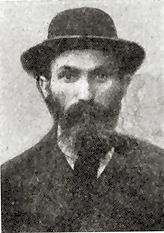
R’ Joshua Gorzholczany (Marmori)
|
|
A pleasant Jewish man with a black
beard and black piercing eyes, a son of Herschel
Tscheshliar – an alert man, full of zest. This
Joshua taught only Gemara, and at infrequent
intervals, also Tanakh.. From time-to-time, he
served as a headmaster at a small yeshiva. His
students had nodifficulty in gaining
admission to the yeshiva at Lomza.
An intelligent and fine-looking
Jewish man, he was well-loved in the city, was both
a Dozor and a Vice-Burgomaster for a time. He spoke
Polish beautifully, and a bit of Russian. He had
some knowledge of medicine, and even permitted
himself the freedom to write ‘prescriptions,’ and
visit sick people just like a doctor –
understandably, without charging a fee. Women would
come to him for blessings, and incantations to ward
off plagues – as if they were coming to some holy
man and rabbi. During the partisan struggle in
Zambrow, R’ Joshua sided with ‘Agudat Israel,’ and
even expressed his ardor for it. |
He made aliyah in 1936, from Kirov, and settled
in Petakh Tikva. There again he earned his reputation and the
affection of the Haredim and the scholars. He would teach a
‘page’ of Gemara to the balebatim and even continued to give a
lesson at the Lomza Yeshiva branch of Petakh Tikva. He died in
Petakh Tikva, in Israel, in the year 1959, and was extensively
honored at his passing. He was eulogized by Rabbi Katz, R’
Yekhiel Gordon – the Headmaster of the Lomza Yeshiva branch of Petakh Tikva, and others.

All that Remains of the Jewish Community, of
Blessed Memory, in Zambrow
Struck by a Lightning Bolt
By Israel Levinsky
On the early evening of a summer Friday, a
consultation took place between four teachers and myself at the
home of the Gemara melamed R’ Yehuda Adaszko: R’ Yehuda, Yeshea
[sic: Joshua] Gorzholczany, Fishl Danielewicz, and Bercheh Sokol.
They decided that I should study Russian and arithmetic in their
chederss – instead of being instructed by the municipal Russian
teacher Szczinka. Coming home, it suddenly became dark: a
downpour ensued, accompanied by loud thunder and terrifying
lightning. A loud clap of thunder, accompanied by a frightening
bolt of
lightning elicited a shudder from the entire town. It then
became apparent that R’ Yehuda had been struck – together with
his son. R’ Yehuda was standing on a table and was pouring oil
into the hanging lamp – and the lightning bolt passed through
the wire and entered R’ Yehuda’s body. The son was saved – but
R’ Yehuda was dead. All manner of things were tried [to revive
him] but to no avail. A gentile advised that he should be buried
in a standing position, and to surround him with ewers of sour
milk. Accordingly, on Friday towards nightfall, a pit was dug.
With the consent of the Rabbi, and for the entire Sabbath,
containers of sour milk were set out – Tehillim was recited
without
interruption – and none of this helped.
The Holy Sabbath had already been disrupted in the shtetl.
Traditional songs were not being sung. For the entire night,
everyone stood at the pit that had been dug out and recited
Tehillim. Two Jewish men were sent to Lomza to fetch a doctor, a
specialist – but he was not effective... On Saturday night, he
was taken out of the pit, the right thing was done by him, and a
substantial funeral was arranged for him on Sunday, which
included many eulogies.
Before the funeral, the teachers decided among
themselves how to deal with the sustenance of the unfortunate
[surviving] family. It was decided that the widow would receive
her share of the tuition paid by the students, that the teachers
would earn, in taking the place of her husband. A specified sum
of money was added to this, and many of the respected women of
the town assumed the obligation to buy their necessities from
the widow in the store that she would open.
The funeral was attended by a large throng. The
crying and wailing of the bereaved were heartrending. His
friends eulogized him, and his grave site was considered one of
the important ones in the town.

A Group of Yeshiva
Scholars in Zambrow
From the right: Zvi
Ben-Joseph, Berl Paciner z”l, Menachem Wismonsky, and Shmuel,
son of Rabbi Klepfish.
R’ Meir Fyvel Melamed
By Chaim Bendor
I was five years old when I arrived to learn at
[the cheders of] R’ Meir Fyvel Zarembsky the Melamed. Before
that, I had studied with Herschel the Melamed.
It was a small cheders, with a low tuition fee.
The breadwinner was his wife, Szprinza, who would bake honey
cake and cookies, a lot of which she sold to children for small
coins. On Friday nights she would bank the fires in her oven
and take in the pots of cholent from the town to be kept warm.
Immediately after Purim, the cheders room became transformed into
a matzoh bakery. We, the children, helped the Rabbi oversee the
Kashrut and would sometimes be ‘flour shakers’ and ‘water
pourers.’
His eldest and only son Alter was a culture
activist in town, but sickly, suffering from tuberculosis. There is no doubt that this is the
reason why he never married. He died during the First World War
from his illness. I can still see in my mind’s eye, and hear in
my ears, the bitter ‘weeping’ of all the family members when
this beloved son was taken into the Russian army despite his
ailment, but was immediately discharged.
The Rebbe, Meir Fyvel, was constantly in good
humor, with a smile on his lips, having no complaints to tender
to anyone, despite the fact that he had no small amount of
family troubles. Apart from his three daughters, he raised two
other orphan girls, and held them as if they were his own
children. He was a Ger Chasid. He would lead services from the
pulpit, he would call worshipers up to the Torah reading, would
allocate Hakafot, and his fiery festive voice would bring in
light and joy to everyone.
About ten years ago, I undertook a trip with a
daughter of Zambrow to visit other landsleit. On the way, we
talked about the past personalities of the town, who were no
longer with us. How elated I was, to encounter in the ‘subway,’
two ladies from Zambrow, my teacher, Meir Fyvel’s
daughters...The elder of the two, widowed and without family,
lived with the younger and her family.
This encounter made an extraordinary impression
on me. Since that time, I have met with them more times and
concluded that they were in fact going in their father’s ways
and display his good traits.

Chaim ben David [Chaim Bendor]
(center) To his Right, Baumkoler, and To his Left, Yekhiel
Prawda
R’ Israel Levinsky
|
 |
|
He was born in the village of Kozhidlo, near
Ostrolenka, in the year 1871. He studied at the LomzaYeshiva,
and from there went off to the Lithuanian yeshivas in Skidel,
Orany, and came to Vilna, against the will of his parents –
because they feared that in Vilna he would become ‘spoiled.’
He befriended a poor yeshiva student, Chaim Helfant, who later
on became renown as the leader of the Bund. Levinsky was eager
for a general education and did not content himself with the
Gemara.
Like other yeshiva students without
means, he would go to the municipal gymnasium, wait
for when the gymnasium students would be going home,
and try to spot a Jewish student in their ranks, to
consummate a friendship, and ask for ‘help’ – that
he, or one of his friends, teach him Russian...
In this manner, he acquired the
education of six classes of gymnasium in the span of
two years.
|
He married in Zambrow and became a prominent
citizen. Here is how he describes, in his memoir ‘Thorns and
Flowers,’ how he became a teacher (see below):
He was one of the most active of the Zionist
workers, one of the first who carried on with the work of Keren
Kayemet, of selling ??? from the Jewish Colontal Bank, and
shepherded the introduction of the teaching of Hebrew in many of
the chederss, and undertook leadership in the culture circles
for the young people. In 1905, he drew closer to the work of the
socialists and believed that a socialist Russia would give the
Jews rights and their freedom.
In 1909, he was engaged by Jedwabne to establish a Hebrew school
there. As a good pedagogue and organizer, it was possible for
him to establish this school and place it on a high level.
However, the authorities did not grant him permission to be the
director for the school, because the teachers there informed on
him, accusing him of being a revolutionary. He was compelled to
leave Jedwabne. A year later, he established such a school in
Lomza, called ‘Torah VoDa’ath,’ and he stayed at its helm for
twenty-five years until 1935, when he turned it over to his
comrades, and made aliyah to the Land of Israel. In Lomza, he
was also active in the area of national education, and in
working tirelessly for Keren Kayemet, HeHalutz, and other
Zionist endeavors, and was in the leadership of those caring for
orphans, was also a gabbai of the Great Synagogue, etc.
In Israel, he was the Honorary Chairman of the Lomza Society,
devoting himself to literature, translating a number of
scientific works in astronomy. He published more memoirs and
children’s stories in the literature for the young, and in
journals, and lastly produced a story ‘Gideon Travels to Cyprus’
– which enjoyed a great deal of success. He was lucid up to the
last moment, reading, and taking an interest in everything that
had a bearing on his people and humanity at large. He was
survived by three sons, and one daughter in Israel. His last
son, Yitzhak, was drowned in the Bug [River] in the year 1934,
during an autobus accident. His son, Meir, who was an active
member in HeHalutz, died in Israel.
From My Diary
By R’ Israel Levinsky
(From His Book, ‘Thorns and Flowers’)
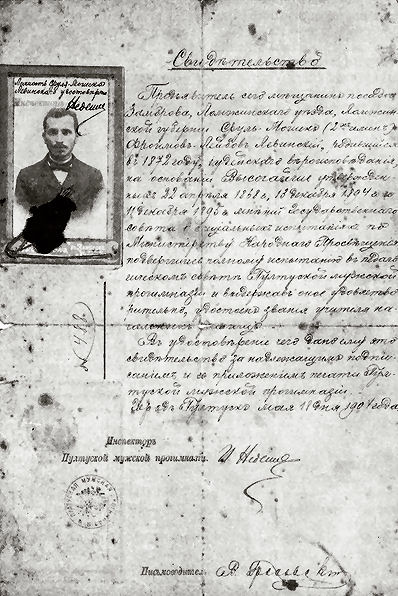 |
|
After being discharged from the Russian military
in Moscow, I returned home to my parents in the village of
Kozhidlo, which lies between Miszinec and Ostrolenka. I very
strongly wanted to travel back to Vilna, and advance my general
education as far as the university. However, my parents
stubbornly resisted: A young man, discharged from the military,
must get married... and so, I was compelled to accept their
proposal. I was married in Zambrow.
My father-in-law, R’ Nachman Yankl
Rothberg, the owner of wagons, promised me support
to whatever extent I wanted. Accordingly, I took to
study. My wife, Tzipa-Rachel, a beautiful woman and
also educated – in accordance with the sense of this
term in those times, could read and write Yiddish,
read Russian and Polish (only the alphabet), knew a
bit of arithmetic, agreed with my course of action.
I obtained a good comrade with whom
to learn: Benjamin Tanenbaum, son of Chona, and
Mashkeh, the owner of the carriages. He was capable,
knew how to learn languages and was prepared to
graduate according to Russian standards. He had no
friends in the Zambrow of that time, so we studied
together.
|
Above:
The Teaching
Certificate given to R’ Israel Levinsky by the Russian
Pro-Gymnasium in Pultusk, in the year 1901.
The first Great Fire broke out, and my house,
along with the houses owned by my father-in-law were burned
down, and I had to seek some way to make a living. I cashed in
my wedding endowment, which was on deposit in Lomza, earning
interest – and loaned it out to my father-in-law, to enable him
to build himself back up.
As good fortune would have it, a wealthy Jew came to Zambrow,
Yankelewsky, who was a building contractor for roads and bridges
for the government. His daughter was a daughter-in-law to
Grajewsky the Miller. He was looking for a teacher for his three
sons in Vonkhotsk, of the Radom Province, and I had been
recommended there for this position. I became a teacher, a
profession that I never left.
The Cheders Metukan of Fyvel Zukrowicz
The desire to give a Jewish child a traditional
Jewish education, and along the way also inculcate general
knowledge, and the central point: a knowledge of the Hebrew
language and general Jewish history – gave birth to the ‘Cheders
Metukan,’ which did not evolve out of the traditional cheder,
and the more formal schools had not yet attained.
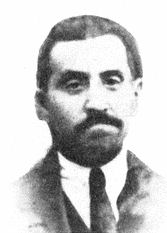 |
|
The
concept of the Cheders Metukan, was an attempt to
reform the [classic] cheders, and raise it to the
level of a volksschule. In addition to learning
Hebrew there, as well as Pentateuch with Rashi
commentaries, arithmetic, history, geography, Tanakh
and Hebrew, were also taught, along with the
language of the country, etc. Fyvel Zukrowicz opened
such a cheder, approximately in the year 1911.
His cheder developed a
little at a time, and later on became a religious
Jewish volksschule. He was a well-informed man in
many fields, (educated at the higher yeshivas in
Lithuania), and in general Haskalah. He was
influential among the enlightened circles in the
city, and was redolent with a love of Zion.
Reb Fyvel Zukrowicz |
Fyvel Zukrowicz instituted a Zionist leaning in
his school, despite the fact that the fanatically religious were
opposed to it. For many years, his school was a bastion of
Zionism, and a place for support of Keren Kayemet, a place where
Zionist committees met, and a place for worship by Zionists on
the Sabbath and Festival days, which had moved over there from
the home of Shlomo Blumrosen, and became a center of all manner
of national endeavor.
He surrounded himself with good teachers from
the local intelligentsia, and from there he spread the use of
the living Hebrew language into the city.
R’ Zerakh Kagan opened a second Cheder Metukan,
the son-in-law of Meiram and Miriam the ‘Wig Maker’ (Bursztein).
Kagan instituted the teaching of Hebrew as the appropriate means
of oral communication, and was punctilious in his observation of
correct grammar.
The two assistants to Fyvel Zukrowicz, Shmulkeh
Golombeck, and Berel Kawior (the husband of Rachel, the daughter
of Michael’ke Finkelstein) from Sniadowo, later on opened their
own schools of this kind in Zambrow.
In 1923, in Kirov, the Cheders Metukan of Mr.
[Yaakov] Tobiasz of Novgorod was added. Tobiasz was active in
the Tze‘irei Zion movement, one of the leading activists of the
burgeoning Hebrew culture, and was a man of considerable
influence in literary circles and an intensely loved and
respected teacher.
As regards the teacher Zukrowicz, his son, Chaim
(a member of kibbutz ‘Ramat HaKoveysh’) tells:
My father was the youngest son of Nahum and
Chaya, who were among the enlightened folk of the city, and of
the venerable educators of the prior generation. They raised a
generation of scholars, of study, education, and set hundreds of
students on the path of the study of Torah, knowledge, Judaism
and personal character. He received his education in the
yeshivas of Lithuania. There, he ‘strayed’ and began assiduously
to study the Hebrew language, its literature, the national
language, and general [sic: secular] knowledge. He opened the
Cheders Metukan in Zambrow in 1910, in Kirov. He was subverted
by fierce opposition from the Rabbi and several of the fanatic
balebatim. The fanatics ripped off the notices from the walls of
the synagogues that announced the establishment of his school,
doing so even on a Festival holiday. And as soon as he opened
the school, the foundations of the building were damaged. The
Rabbi and the fanatics threatened the parents who would send
their children to a place like this with excommunication.
However, he was not intimidated by them. His approach to
education, his attitude towards the children and the Torah that
he taught them, helped him develop an admirable reputation in
the city, and his school was always full of students, with no
vacancies. He was a teacher and educator to parents [as well].
By being an ardent Zionist, being active and a worker in the
Hovevei Zion movement, he would speak from time-to-time, at
Zionist gatherings in the city that took place, as you can
appreciate in secret – out of the maligned view of the
constabulary. He instilled his ardor for Zionism in his
students, and over time many of them made aliyah to the Land of
Israel as Halutzim and pioneers. He gave his students a national
[sic: sectarian] education, teaching them to walk erect, with a
straight back, and to take pride in their Jewishness. He also
conducted plays and sports at the school, and supplemented them
with promenades during the summer months, to the surrounding
forests, Wondolk, Czyczurok, and even to Czorny Bor. And the
students would frequently lead such walks with a blue and white
flag at its head. On one occasion, a policeman wanted to seize
the flag and tear it up, but Zukrowicz took the flag out of the
boy’s hands and did not permit the policeman to touch him.
Because of this, he was taken to court, and paid a fine of
several zlotys for disobedience and resistance shown to a
policeman. He paid the fine willingly, but didn’t let the
policeman touch our national flag.
Every important event in the Jewish world, and
especially the Zionist world and in the Land of Israel, was
recognized and recorded in his school. On the day of the Balfour
Declaration, he hung a large sign in school, proclaiming ‘Come,
awaken, for your light has arrived,’ and on the day that the
[sic: Hebrew] University opened in Jerusalem, he drew a huge
sign saying: ‘For from Zion the Torah Shall Come Forth.’
During the Sabbath and Festival days, his school
served as a gathering place, in which the Zionists entered to
worship, in their own special minyan. They spoke Hebrew among
themselves, donating to Keren Kayemet if they were called to the
Torah, or to Keren HaYesod, HeHalutz, and like causes. How his
heart was pained, when in the second half of the 1930's he saw
the spiritual decline among the ranks of the young. The general
Polish school, the ‘Szkola Powszecna,’ sunk its talons deeply
into the young people and even a Polish gymnasium came into
being in the city. These non-Jewish schools [ironically] became
filled with Jewish students, from the ranks of the balebatim.
The students there attended class even on the Sabbath, and in
doing so not only desecrated the sanctity of the day, but any
number of them grew apart from the Jewish experience, and for
this reason, their soul silently wept. In the last years before
the Holocaust, his school declined, together with the rest of
these Jewish schools in the city. Many parents adopted the
custom of sending their children from their early childhood
training directly to the Polish school, and retained a melamed
at home for several hours a week, to teach them Pentateuch with
Rashi commentaries and a little bit of Gemara.
At that time, my father was preparing to shut his school down
and make aliyah in order to realize there all of his dreams from
early on, and that he cherished forever. However, he delayed the
schedule. On 27 Av 5699 (August 12, 1939), he passed away –
after having served as an educator in Zambrow for about thirty
years. He was privileged to see his two daughters and son Chaim,
the writer of these lines, make aliyah and settle in the Holy
Land.
A Teacher and Educator
By Yaakov Tobiasz
(Tzfat)
(Memories)
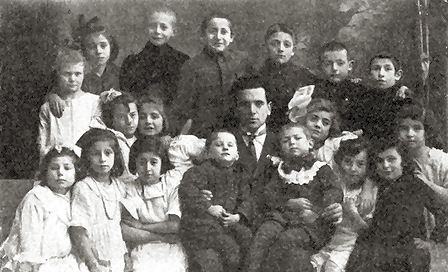
Yaakov Tobiasz with
his pupils
I have faint recollections about Zambrow from my
early childhood – but it was only in 1915 when we arrived in
Zambrow, being homeless, after the expulsion from Novgorod,
where I was born, by the Russian army, at the peak of the First
World War. Since that time, I have tied my life to Zambrow. We
took up residence on the Uchastek. I studied Gemara with the
Kolno Teacher and Director R’ Yaakov-Avigdor Brizman, also
homeless (later on the Rabbi of Jedwabne). He once introduced me
to the Zambrow Rabbi, R’ Regensberg z"l, who gave me a pinch on
the cheek, and wished for me that I not be ruined [sic: lose
your way into secular culture]. I began to investigate the
contents of Enlightenment books. One neighbor, a Russian
surveyor, began to teach me arithmetic, and ‘Khezki Mark, our
neighbor who was a student, drew me nearer to the Enlightenment
literature. My father died that very year, during the
intermediate days of Passover, in the Zambrow military hospital.
The Kolno Rabbi and Director came to comfort us as the bereaved.
I gave myself over to the study of the Talmud at the Bet
HaMedrash, and even established a chapter of the youth group
‘Tiferet Bakhurim’ there – for ??? study, and to maintain
oversight of the books: their order, binding, and even
acquisition..
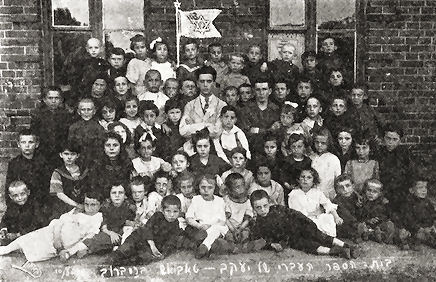
The pupils in the school of Yaakov Tobiasz

A Class in
Public School with the teacher, Lola Gordon
It was first only six years later, in 1921, that
I returned as a teacher and director of a Hebrew school. I was
recommended by the balebatim: Menachem Donowicz, Avcheh Frumkin,
and Israel Kossowsky, as well as the members of ‘Tze‘irei Zion,
whom I knew from my time in the area, such as David Rosenthal,
Yaakov Jakbowsky, who persuaded me to come to Zambrow. The
Rabbi’s ‘Cossacks’ fought me vigorously. The owner of my school
building, Prawda, became frightened, and wanted to break the
contract with me. However, the balebatim stood up for me,
parents of my students such as: Fyvel Rosenthal, Leibl Karlinsky,
and others, At first, only boys were students, the girls going
to the local Polish government school, but little-by-little, the
girls also captured a place on the benches. My school earned a
good name, with its curriculum, presentations, children
evenings, trips, a children’s journal, a children’s library,
etc. The children loved me a great deal.
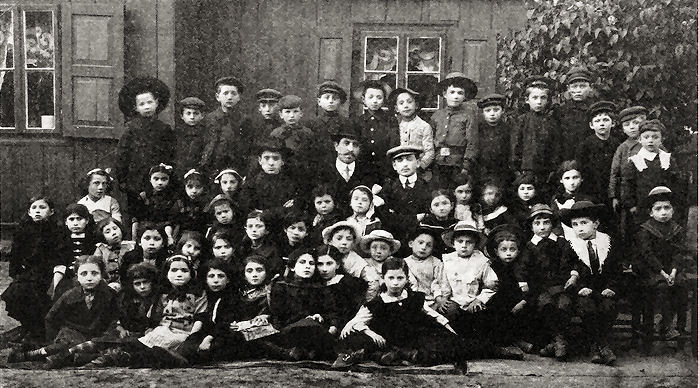
The School of Fyvel
Zukrowicz
In the middle, seated, are the teachers, Sh. Golombeck, F.
Zukrowicz, and Joshua Domb
On Shavuot, in 1922, when my mother came to
me for a visit – she suddenly died. This upset me terribly.
She was buried in Zambrow, beside my father – and this tied
me to the city forever. As a mourner, I would lead services
in the White Bet HaMedrash. One time, when the Rabbi
returned, extremely agitated with zealotry from the Agudat
Israel conference in Vienna, he communicated an order from
the conference, suddenly, between afternoon and evening
services at the White Bet HaMedrash, bursting into tears,
saying: Brothers, do you hear that in the Land of Israel
there is a Dr. Mosensohn, let him be cursed, may his name be
eradicated, who teaches his pupils to violate the Sabbath,
and to write on the Sabbath, let us excommunicate him. Let
us all say, ‘curse Dr. Mosensohn, and everyone answer, Amen!
I took this as an insult, and I shouted out: ‘Enough, do you
know what you are doing?’ And a tumult ensued about me, and
when it died down, I approached the pulpit, to lead the
evening service – the Rabbi shoved me aside and said:
‘Shaygetz, I hereby remove you from the pulpit, and you will
get a slap in the face in short order... I left the pulpit,
without reaction, out of respect for the Rabbi, who was a
great Torah scholar, a tzadik and honest man. The Rabbi
personally went to lead prayer from the pulpit [in my
place].
On the following day, members of Tze‘irei
Zion, on whose head tefillin hadn’t lain for quite some time
--accompanied me, in the chance that the Rabbi would once
again not permit me to lead services. The Rabbi enveloped
himself in his prayer shawl and let out a groan. I began to
pray from the pulpit.... In a short while, he sends someone
to summon me to him: he wants me to teach Hebrew to his
grandchild, Fruma-Liebcheh, the daughter of the Rabbi of
Sniadowo, R’ A”Y Klepfish. I taught her for several months,
Her husband later became the author, and renown Yiddish
writer in Vilna, Chaim Grade. She was exterminated.72
In that same
year, my sister died, and I remained solitary and depressed.
It is only thanks to my students, the dear children of
Zambrow, that I was able to maintain my composure and
continue with my work, and also thanks to the balebatim the
parents of the children and my neighbors who kept an eye on
me maintaining concern and seeing to my welfare. Among them
was the family of A. Greenberg, the owner of an ironmongery,
and especially his genteel wife, who were my good neighbors,
looked after me. Not once did I hear her calling to her
eldest daughter: Rachel, I think he hasn’t eaten anything
yet today, he hasn’t drunk any milk, etc. And they would
hurry, bursting in on me, and taking care of all my needs.
I remained connected to Zambrow, even after I
left it. At every opportunity, I would come for a visit. The
Jews of the city were unique in their kind: all diligent,
working people, people of action, and taking things into their
own hands, far removed from assimilation. Zambrow, which lay on
the crossroads between Ostrow and Bialystok – was suffused more
that ‘Litvak’ Bialystok [with that tradition] and was a far
distance from Ostrow, the Chasidic city. Before my eyes they
stand and speak to my heart: Leah Zukrowicz, Dina Golombeck,
with her literary excerpts. Bracha Zukrowicz, Paula Wiezhbowicz,
with her smile, who along with her father, Chona, the one who
intoned ‘Mekhalkel Chaim’ so engagingly during the high Holy Day
prayers at the White Bet HaMedrash, the hearty laugh of the ‘I
don’t care’ Moshe’keh Gottlieb, in the library hall (in New
York, he met me and asked me in a questioning and merry tone,
???: And we never had a library!), the constantly questioning
eyes of Abraham Krupinsky, and the juridical voice of David
Rosenthal, Simcha Rosenbaum, always so sure of himself; Yaakov
Donowicz, the pessimist – who saw everything collapsing before
him. Fishman, who would roll on the white snow after noon in the
marketplace; Nathan Smoliar, the speedy one, with the good, and
smiling, eyes; the young midwife, Bikhubowska, so delicate and
gentle; the young folk, Slodownik, and Matityahu Gorzholczany,
and others — all these, the dear sons and daughters of Zambrow,
who will remain in my memory forever for a blessing. And from
among the shining balebatim of the city there were: R’ Abba
Rakowsky, the eminent scholar, from whom I was privileged to
receive his lore, and to enjoy his illumination, when, late in
his life, he returned from Russia, an exhausted wanderer,
without anything to his name. Avcheh Frumkin, the perceptive man
with the broad heart, Moshe Blumrosen, with the appearance of a
Tolstoy, who worked in the municipal administration, an
enlightened man who loved to listen and refrained from making
others listen to him. R’ Shlomo Blumrosen, his brother, with his
magnificent carriage, like the well known generous soul he was,
knowing not to step on even a worm while waking, a man of great
generosity when it came to Zionist undertakings, never seeking
to avoid responsibility or make excuses; R’ Yaakov Zukrowicz,
fluid in his step and dressed magnificently who followed the
young generation and did not seek the spoils of following the
fanatics, even though they held him in high esteem. Menachem
Donowicz, the punctilious one, one step ahead, and two steps
back, the Gabbai of the Chevra Shas, peering into books from the
outside world, and pursuing only the enlightenment of the
daughters of the city. Mordechai Rivkov, who constantly dreamt
of the Zionist Party first, and was the first to buy a raffle
ticket from each and every endeavor. And there were many others
– whom it is difficult for me to recall after forty years and
more.
It is [now] more than forty years [that have
gone by]. Zambrow, its youth, its fine library, into which I
invested so much energy, its balebatim – scholars, ordinary
workers, decent Jews – they all stand before my eyes alive, and
I will never forget them.
Before I left Poland for the Land of Israel in
the year 1946, I also went back to Zambrow. I did not recognize
it. Only the cemetery, with the sporadically visibly inscription
of Po Nikbar [here lies buried].. Remain as witnesses, struck
dumb, yet shout and scream to the heavens about what was
done to the six million Jews, and the sacred community of
Zambrow among them.
From the Words of Students
Naomi Blumrosen
...and the studies were interesting. The
students were drawn to the curriculum. We spent most of the day
between the walls of the school, because even after noon we
returned for additional tasks: changing books at the school
library, preparations for celebrations and promenades and like
things. The many strolls we took in the nearby forests,
arranged by the school were interesting, each previously
designed from the beginning to cover some subject in nature, or
having to do with literature about Israel. The plays put on
during Hanukkah, 20 Tammuz, and others – that the teacher Tobiasz wrote himself – met with success, and the revenues were
dedicated to the school library.
And here is a small episode that indicates the
great commitment of the teacher to his school: One time, on Tu
B’Shevat, we were occupied in making preparations for the
celebration. The tables had been spread with fruits from the
Holy Land, when a telegraph notice came to the teacher: his
sister had fallen very ill and asks that he come to Warsaw
immediately. The teacher lowered his head into the palms of his
hands, was lost in thought and decided: he did not want to abort
the joy of the children, nor did he want to put a stop to their
creativity. He will travel the following day. The celebration
went off successfully, and with joie de vivre. The Land of
Israel stood before us that day, in the fullness of its splendor:
in the fruit from there, and with the magical spirit found in
the heart of a Jew. The teacher did not find his sister alive,
and we mourned her together with him.
Aryeh Kosssowsky
I entered Y. Tobiasz’s school for study at the
age of ten. I immediately felt a great change that had come into
my life: the approach of the teacher to the student as a friend,
no recourse to a switch or whip. And the course of study –
Hebrew, taught in Hebrew. We also studied manners and etiquette:
how to hold a spoon, fork and knife during eating, to say ‘Thank
You Very Much’ to our parents after a meal, to rise before
someone older than you, to give alms to the poor, even if we
have no extra money – to then share our piece of bread with
them. The room was always well ventilated. The walls were
covered in pictures about geographic subjects, nature, and the
Homeland. After each hour, there was a brief recess – to catch
one’s breath. We even once surprised our teacher: on the third
day of Chanukah, which was his birthday, we secretly organized a
celebration that involved a play with songs and palm trees....
from time-to-time, he would read to us from the literature of
the Land of Israel, from fairy tales for the young, news from
the newspaper, etc. We learned many chapters of the Tanakh by
heart, and thanks to that the Tanakh remains on my lips to this
day. On once occasion, the writer Yakir Warshawsky visited us
during class hours. He tested us in writing and orally, and
found us instructed, knowledgeable in Torah and fluent in the
grammar of the language, and also being attracted to the
threshold of the Land of Israel.
Years passed, and to this day in the Land of
Israel, when I follow the plow or work in the barn, in the
garden, or storehouse, I feel and value the Hebrew and national
education that I absorbed in his school. As to my preparation
for the Land of Israel, I received it directly from his mouth.
The Russian Public School
At the end of the previous [sic: 19th] century,
the Russian government founded a public school in Poland for
Jewish children, in which the language of instruction was
Russian. The objective was aimed more towards the Russification
of Jewish masses, and to distance them from Polish culture,
rather than to inculcate culture and knowledge into Jewish
children. The agenda consisted of one high school class, at the
border of a gymnasium class. The course of study – three years.
However, by and large, most of the graduates of this school did
not even get to the level of the first grade in a gymnasium.
One teacher taught all three of the classes. The
dominant number of the students were girls. Boys were few and
far between, mostly from among those who saw no ‘boon’ in
attending cheder. There were also few that studied at the Russian
school in the morning, and after noon – went to cheder. The
teachers placed emphasis on knowledge of the ‘Motherland.’ When
the ‘Inspector’ would arrive from Lomza – the beginning of his
examination was: Do the children know the ‘title,’ that is: the
proper honorific with which to address the Czar, his Queen, his
widowed mother, the Crown Prince, his heir, and his uncle, the
Grand Duke. [They needed to know] when do the holidays of the
kingdom fall (the Galiubka, or Prazdnik); the day of the
coronation of the Czar, his birthday, the date of birth of the
Crown Prince and Heir, etc. It was this knowledge that the
Inspector looked for at the outset, even from the students that
attended cheder, whom he came to test for their knowledge of the
Russian language. During the Sabbath and Jewish Festival
Holidays – the school was not open. Teachers, with some feeling
of spirit, would sneak in a bit of ‘Zakon Buzhi’ – religious
instruction in the school, and would tell the older students
stories from scripture and about the portion for the holiday.
From among the teachers, I recall the following:
Shapiro (an urbane Jew, and knowledgeable in Hebrew – who didn’t
think much of my work), Sawirsky (from Vilna), Szaczynko (from
Rygrod) – an Enlightened man, drawn to Zionism, beloved by the
city, but not the régime, because of his progressive ideas. His
oldest son, Leib, was the pride of the Russian gymnasium in
Lomza, and his young son, Yitzhak, studied in Germany at a
agricultural school for purposes of preparing to make aliyah to
the Land of Israel. After him – the teacher Friedberg, a
negative sort of person, who did not become endeared to the
people because of his love of money. He worshiped at the White
Bet HaMedrash, and on once occasion, on a Sabbath, after
Passover, he ascended the Bimah, and announced: If Russian
lessons were not given in the cheders – he will begin to eat
bareheaded, and without washing his hands... The threat
succeeded on his part, because the melamdim were afraid of him,
fearing that he would send the Inspector to them, and disqualify
their cheder. After him came Leib, the son of a bookseller from
Lomza: lean, tall, and blond, he was more of a Russian official
than an educator of Jewish children. With the outbreak of the
war – he went over to Russia, as was the case with all
appointees of the crown. From that time on, the Russian school
ceased to operate, and in its place, as we shall see, came a
Yiddish school, and after that, under government pressure, a
Polish ‘Szkola Powszecna.’
The Yiddish Public School
In the year 1916, during the time of the German
occupation, a network of Yiddish schools began to be opened in
Poland. The German authorities viewed this with favor because
they saw ‘Yiddish’ as being close to German and also a barrier
against Polish assimilation on one side, and against the
influence of Zionism on the other. In Zambrow, those who stood
at the head of the battle for such a school, namely, that
Yiddish be the language of instruction, and a firm national
tendency toward it, were: Joshua Domb, and Nathan Smoliar. Domb
was an idealist and a gentle soul, possessing a very broad
amount of Russian Enlightenment, which he had acquired in
Odessa, and was also educated in Judaism and Hebrew culture. He
was fluent in Hebrew. He was drawn to Poaeli Zion, and had a
leftist outlook. His comrade in this was Nathan Smoliar, a
pedagogue from Dolfuss, and educated in the Zambrow cheder
[system], a graduate of the municipal school in Czechanowczy,
and the Teachers’ Institute in Vilna, and was also an ardent
member of Poaeli Zion, to the left. Together with Lola Gordon –
a graduate of the Russian gymnasium in Lomza, who was drawn to
the ordinary Jewish folk, even though she was distant from them
[sic: in outlook] since the time of her education.
It was these who successfully opened the
Yiddish public school in the city. Rachel Mark, a teacher by
good fortune (???) also joined up with them afterwards to teach
general studies. The school was set up in premises within the
house of Sziniak, on the Bialystok road, and its principal was
Nathan Smoliar, to who other teachers were added and changed.
among them: Nadler, [and] Gutman.
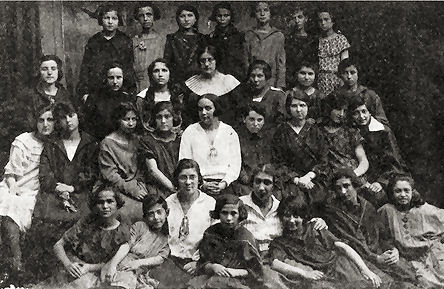 |
|
After a
while, in which the Poles rotated in their
government, they changed this school into a
government school but – the language of teaching was
Polish instead of Yiddish. Nathan Smoliar did not
agree to remain on as principal in this school, and
establishes a new Yiddish school, called ‘Borokhov,’
as an extension of TzYShO (Tzentrale Yiddishe Shul
Organizatzia, Warsaw). His place, as the principal
of the previously mentioned school, that was
transformed by the ‘benefactors’ of the régime, into
a ‘Szkola Powszecna,’ was taken by Lola Gordon – a
teacher of tradition to the Jewish children, a good
and talented educator – but subordinated |
|
A Class in
Public School with the teacher, Lola Gordon |
to the demands for Polonization by the régime.
After her, her sister led the Polish school – Niuta Gordon-Wilimowsky
(today in Israel). After a while, when the reputation of Nathan
Smoliar spread as a successful teacher and an experienced
pedagogue, a trained principal, and a talented organizer – he
was taken away honorably to Warsaw, to be the principal of a
‘Borokhov’ school there, also by the left-leaning Poaeli Zion,
and here too -- he was outstandingly successful, to the point that he was considered as one of the
best of the Jewish pedagogical resources in Warsaw.
The Volksschule Named for Borokhov in Zambrow
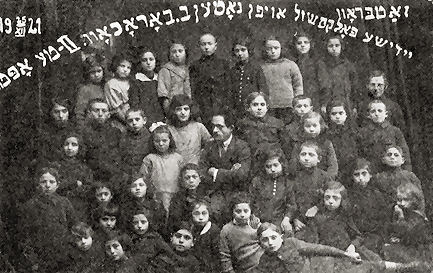
The "Borokhov" School
The Yiddish Volksschule, named for Ber
Borokhov, was founded with great difficulty in the year 1921 by
the Poaeli Zion, with the help of parents and friends:
The school was located on the ‘Platz’ (going to the
Koszaren), at the house of Moshe-Lejzor Sokol. It opened
with only two classes. Most of the students (boys and girls)
were the children of working-class parents, and even though they
should have paid tuition, which they only were able to obtain
with difficulty, nevertheless they sent their children to the
school with a great deal of commitment. The school provided a
Jewish-worldly education. Much room was made there for Jewish
literature, for the classic Jewish history, etc. A love for
Jewish traditions was also implanted into the children. At each
Jewish Festival Holiday, the teachers and the children prepared
their lovely presentations, using scenery created by themselves,
including recitations, song and dance. These presentations, in
which the children were transformed into birds, angels, little
trees, and snowflakes, had a great success in the shtetl.
The Firefighters hall, where these presentations were held,
would be filled to overflowing. Primarily, the school had a
reputation for its children’s choir, which would sing many
beautiful children’s songs, in three or four voices, and also
pieces from classical music, Beethoven, Chopin, Haydn, and
excerpts from operas.
The Yiddish Volksschule was a second home
for the children, and for others – literally their only home;
because this was where they were able to forget all of the
troubles and worries that beset their real homes. The
relationship of the teachers to the children was extraordinarily
of a full heart. The teachers worked under their difficult
material circumstances, barely making a living, but despite this
they were dedicated to their work with all of their heart. They
were paid with the love and loyalty of the children.
The teachers used to be engaged with the
students even after classes; they would lead discussions,
explain matters to them about social life, about the struggle
between classes. During the summer and on Saturday mornings when
the weather was good, they would organize expeditions to places
in the vicinity of the city. An important event was the
publication of a journal by the children, written and edited by
the children themselves, containing poems, stories,
characteristically about educated people, and reviews of books
by Yiddish writers.
Those circles, comprised of religious fanatics,
looked with disfavor on the Yiddish Volksschule. They
held that the children were being give too liberal an education.
They went so far as to have one of the teachers excommunicated.
The Volksschule existed for barely six
years. During that time, it demonstrated the capacity to rally
all the progressive elements of the shtetl around itself.
In the school, there also existed evening courses for workers.
Speakers came from Warsaw, who gave interesting lectures. But
this was not in accordance with what the official authorities
wanted. And so, on a nice day in May 1927, a policeman entered
the school and advised that the school was being closed. This
was a terrible blow to the children. They were being deprived of
the very thing that they valued and treasured the most.
Those few students, who are still alive, recall
with sorrow, their dear school and their teachers who are etched
into their memory forever. Let us show respect to our
exterminated teachers and fellow students.
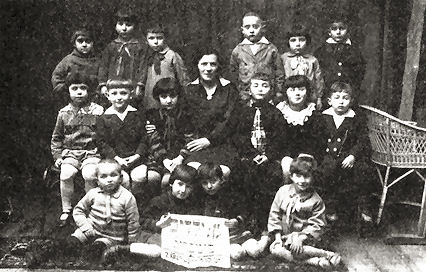
Kindergarten
Here is a group of former girl students, who are
living in Paris today: Chana Sokol-Zilberberg, Faygl
Stupnik-Astrinsky, Zlatkeh Sosnowiec-Rothstein, Esther
Smoliar-Szlewin, Belcheh Stupnik-Kwiat.
The Yiddish-Polish Volksschule
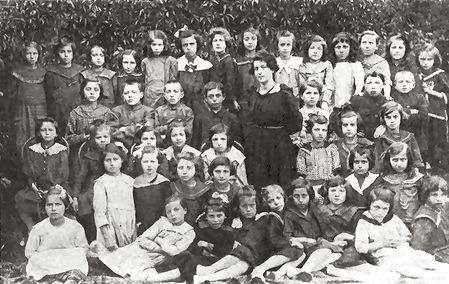
Class in the
Yiddish-Polish School - I
The Polish authorities laid an eye on the
Yiddish Volksschule, which in its view was a revolutionary
fortress, and on one fine morning closed the school that had
been in existence for six years, and in its place opened a
Polish-Yiddish Volksschule. Its objective was to polonize the
Jewish children, tear them away from Jewish culture, and implant
a love of Polish into them. At the beginning, a special teacher
taught them ‘Jewish religion’ two to three times a week. Later on, this
too was discontinued. The ‘Szkola Powszecna.’ openly applauded
assimilation, and an opposition to oppose a Jewish national
upbringing. In its ranks, there worked not a few clandestine
communists who held themselves equal to the Poles, with their
hatred for Yiddishkeit and national education.
Of the twenty cheders in Zambrow during the time of
the Russians – barely three to four remained in those last years before
the Holocaust. This is because the ‘Szkola Powszecna’ swallowed
up the children after the authorities compelled the children to
attend this school, and a little at a time closed the cheders.
Also, the Yiddish-Hebrew schools could not continue to exist
because of harassment by the authorities, and also because of
the bad economic circumstances of the Jews in the city. The
Polish school was free of charge, depending on taxes, while the
rest of the schools required that tuition be paid.
A small part of the parents would send the small
boys from the Polish school to an afternoon cheders, or an
evening cheder...
Before the Holocaust

A Class in the
Yiddish-Polish School - II
In those last years, a religious school for
girls was also founded, ‘Bais Yaakov,’ under the aegis of
the Rabbi. The head teacher was the Rabbi’s step-daughter. The
school was in the ‘wood house’ of the White Bet HaMedrash.
The ‘Centoz,’ which was concerned with the welfare of the poor
and weak children, turned over the food allocations for the
schools and the cheders to ‘Bais Yaakov.’
The fanatic Jews, who a half-generation before
fought every reform in national-religious school and harassed
the teachers for their ‘liberal’ view of education – now bowed
their heads for the assimilated-gentile school...
During the short Russian occupation in the last
[sic: Second World] War, a sort of permission was granted to
found a Yiddish Volksschule in Zambrow along with a Jewish
gymnasium. But in a short time, the Russians pulled back and
left the city to the Germans.
The Spinoza of Zambrow

A Class in the
Yiddish-Polish School - III
In 1938, there was a frightful winter. There
were immense frosts, couples with childhood illnesses.
Accordingly, a search began for transgressions in the city: who
is it that is the cause of such intense suffering in the city?
And they discovered that the teacher of the Yiddish school, from
the TzYShO network (the Central Jewish School Organization) –
was teaching the children to be against Yiddishkeit, telling
them they should write on the Sabbath. People observed how he
would tear off the mezuzahs that were on doorposts and trample
on them with his feet... and it was then left to the Rabbi and
his followers to make an end to these troubles and place the
teacher in excommunication. So Binyomkeh the Shammes ran, and
brought the sinning teacher to the Rabbi: a skinny and tall
young man, pale, dressed in a thin coat, shivering from the
cold.
The doors were sealed. The Rabbi lit two black
candles. and one person blew the Shofar: Tekia, Shevarim, Teruah.
And the Rabbi turned to him, asking him nothing: ‘Be advised
that we are excising you from the body of the Jewish people! May
you be cursed both in your coming and going! And may he be
cursed, who will come in contact with you, or have anything to
do with you!....’
And so the Rabbi finished, and the door was
pried open, and the accursed Jewish teacher, as pale as the
wall, even scrawnier than before and taller than before,
silently shuffled out, barely able to stand on his feet...
The Polish Gymnasium in Zambrow
By Zvi Zamir (Herschel Slowik)

Zvi Zamir – Herschel
Slowik
In 1918, with the new independence of Poland, a
Polish gymnasium was established in Zambrow. Quite a number of
Jewish children were students there. They had to put up with
anti-Semitism, and having their parents harassed by the Rabbi
z”l and several of the balebatim who looked at the school where
the children were compelled to write on Saturday, as if it were
an apostasy. And so, a few of the parents became fearful of the
Rabbi’s threats and took their children out of there. The Rabbi
especially took issue with Berl Golombeck, who was a prominent
member of the balebatim, among his people in the Red Bet
HaMedrash -- threatening to excommunicate him if he does not
take his daughter out of the gymnasium. All the Golombecks were
upset by this, and came out against the Rabbi. The Rabbi was
compelled to transfer over to the White Bet HaMedrash.
Studies at the gymnasium were on a high level.
The director, Mayewsky, a well-known pedagogue and an educated
man, did not like Jews and referred to the Jewish students as
‘foreigners who speak Polish only in school’ – yet, despite
this, he would often hold up Jewish students as role models in
contrast to the gentile ones, noting their understanding and
style, understanding and diligence. As to the Jewish students,
part of them were inclined to assimilation and saw their future
in the new Poland. The larger portion however, was Zionist in
its orientation, from all parts of the spectrum. For example: M.
Baumkolar, a talented and outstanding student in school, was an
ardent Marxist outside of school and was a member of the leftist
Poaeli Zion Youth and founded a student group for the laboring
classes in the Land of Israel.
He invested a great deal of his strength and
energy into this group, and thanks to him many Jewish students
who were diligent in their study of Polish literature, were
saved from a spiritual assimilation and gave themselves over to
the concept of our national rebirth, studying Jewish history,
reading Hebrew and Yiddish literature, and taking an interest in
everything that transpired in the Land of Israel. As a result,
no small number of them ended up coming to Israel, some sooner,
others later.
Apart from the Polish gymnasium in Zambrow, no
small number attended the Yiddish-Polish gymnasium of Dr. Sh.
Goldlust in Lomza. Others pursued study in Bialystok and Warsaw.
Of these, some did so in the ‘Takhkemoni’ middle school and in
other schools. Together, they brought credit to Zambrow youth
and brought culture into its ranks.
The gymnasium, even though it was anti-Semitic
in its cast, was for us, the children of cheder and Gemara, a
ray of light and education.
Alter Rothberg

Alter
Rothberg |
|
He was a gifted
child, the only son of his father, R’ David, the
Wagon Driver (born in the year 1896). The
melamdim constantly spoke highly of him. At the
age of about thirteen, he traveled off to study at
the yeshiva in Lomza. He studied there for about
three years and then transferred to study at the
yeshiva in Telz, which enjoyed a high reputation for
its scholars. There he ‘went astray:’ He began to
diligently study subjects outside the Gemara, Tanakh,
grammar and Russian, read pamphlets by Enlightenment
authors, and became active in Zionist endeavors.
When the First World War broke out – he returned to
Zambrow but he was a different person by then. His
father had already given up on the idea that his son
might become a rabbi. He continued to acquire an
education. He made his debut as a teacher in his
uncle’s school, his mother’s brother, Fyvel
Zukrowicz. During the establishment of the Polish
Republic, he became a teacher in Bialystok. There,
he married a genteel woman, Rivka Halle, and built a
Jewish national house and relentlessly taught
himself worldly subject matter. |
Later on he became a teacher in the Jewish
gymnasium in Suwalk and became one of the principal intellectual
forces there. He then returned to Bialystok, settled down there,
and later on became a teacher in the Yiddish-Polish gymnasium.
During the vacation months, he sat for the government
examinations and earned a Polish diploma, as a Polish gymnasium
teacher, preparing himself for an academic title, and afterwards
– to go to the Land of Israel. In this time, his three children
grew up. For this entire time, Alter was active in Bialystok on
the National-Cultural front. He was beloved by everyone for his
merriment and joie de vivre. He was reckoned as one of the best
pedagogues in the city, and he was killed with his entire family
in the Bialystok ghetto on that Black Friday (August 20, 1943).
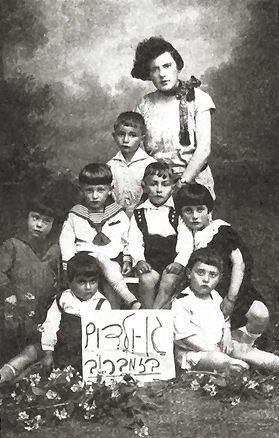
Kindergarten in Zambrow
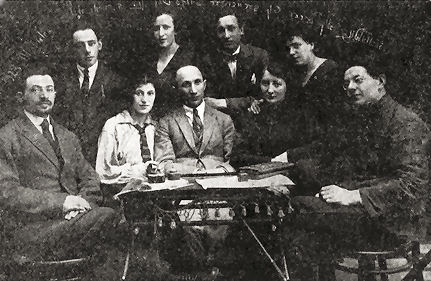
The Teachers’ Committee of the Borokhov
School
Standing: Moshe Eitzer, Lindenheim, Shimon Rubinstein
Sitting: G. Fishman, (Rachel) Mark, N. Smoliar, Sarniewicz, Yudl
Rubinstein
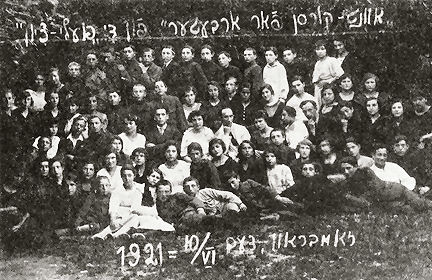
Evening courses for workmen
10 June 1921

A Class in the Volksschule - I

A Class in the Volksschule -II

A Class in the Volksschule - III

A Class in the Volksschule - IV,
Nathan Smoliar, Head Teacher (center)

A Class in the Volksschule - V, Lindenheim, the Teacher (center)
The Library
Before the First World War, Zambrow has a small
Zionist library, consisting of Hebrew and Yiddish books, and it
was called ‘Toshia,’ named after the prominent publishing house
in Warsaw, whose agent in Zambrow and its vicinity was Benjamin
Kagan. The library was located in the house of Yochanan
Feinzilber, a member of the Zionist organization. All three of
the brothers, Yochanan, Chaim and Joseph, along with their
sister Rachel (now Lewanda, in Israel) committed themselves to
the library and would trade books. You understand that this was
done on a voluntary basis.
A second library, of Yiddish books, could be
found at the home of Meir-Fyvel the Melamed and baker of honey
cake. His son, Alter Zorembsky, a very aware older boy, an
old-time labor activist, committed himself to this library with
heart and soul. Alter had spent some time in Bialystok, and
there, familiarized himself with labor doctrine, and brought it
back with him to Zambrow. He would be able to attract working
young people to the book, explain to them what they should read,
introduce the author and his work, and later after reading carry
on discussions with them. He was sickly, suffering from a lung
disorder, but despite this, he committed himself to the
education of workers and encouraged them to read. The library
later was transferred to Mr. Pszysusker – a gentle and educated
young man from Pultusk, who, together with his well-educated
wife from the Kuppermintz family, ran a paper business, ??? the
Kosciolna Gasse.
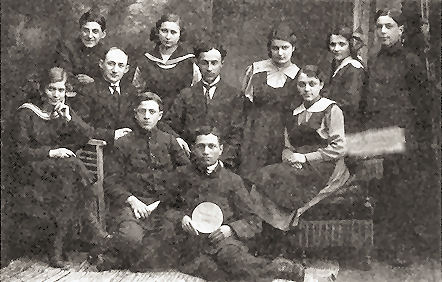
A Workers’ Education Group
Sitting: Chana Wiezhbowicz, Alter Garfinkel, Pinia Baumkuler
The circle of readers grew larger – despite the
fact that the Rabbi and his fanatic accomplices, engaged in
attempts to place the library under excommunication. An attempt
was even made to set it on fire. The library eventually acquired
its own premises, expanded the number of books, with Hebrew,
Yiddish, and Polish books. When the circle of readers was large,
and the reading room unused – the library management would
arrange literary evenings, putting on informative lectures,
discussion evenings, etc.
During the German occupation, in the First World
War, the library was under the influence of the ‘Bund.’ When the
‘Poalei Zion,’ and the Tze‘irei Zion grew strong, they undertook
to spread their wings and obtain control over the library. After
lengthy discussions and fights, the library passed over to the
control of the Zionist workers. It was formally decided that the
library should be non-partisan. Elyeh-Mottl, the son of Yaakov
Schaja (today in Argentina), was nominated as a neutral party to
be the librarian, and let us remember him here for that,
favorably. He was very much committed to his position (you
understand, without financial compensation), and even during the
fairs held on market days, he would leave his store full of
gentiles and run off to fulfill his obligation in the library,
exchanging books, and advising the young people on what to read.
While the library was neutral [sic: non-partisan], the friction
did not cease. Each side suspected the other of a biased
approach to the acquisition of books. This continued until a
certain evening, in which a referendum was passed with a large
majority, deciding that the library should pass to the control
of the Zionists under the name of ‘HaTekhiya.’ This name, which
came from legal Zionist societies, protected the library from
undue suspicion that there were communist elements within. The
government attempted to close the library more than once,
thinking that here is a nest of ant-government parties. The
library struggled and existed for close to three decades,
spreading knowledge and culture among the masses until the Nazi
fire consumed it.
In speaking of the library in each Bet
HaMedrash, in the Chevra Shas, and the Hasidim shtibl, a
‘library of religious books’ could be found. Small groups of
‘book-buyers’ were organized in each house of worship. People
would pledge sums of money, donate their own books, or books
they inherited from their father. Children would often commit to
saving a set sum of money from their pocket change they used to
buy candy, in order to buy a set of the Shas for the Bet
HaMedrash, a set of the Pentateuch, haggadic (The Prophets and
Ketubim) and similar initiatives. These religious libraries also
were consumed and went up in the smoke, together with those who
were the ones who perused their books.
Drama Circles
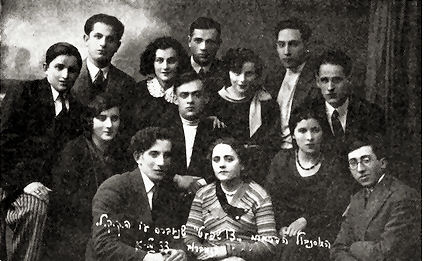
The Keren Kayemet L’ Israel Drama Circle
The ‘Bund’ Drama Circle
Even before the first Great Fire, a theatre was
set up in Zambrow. The interested young people of that time had
put on the play, ‘The Selling of Joseph’ on Purim in the Women’s
Synagogue, with the female parts also being played by men...
Despite this [accommodation], the local actors were roundly
cursed.
On Purim, the yeshiva students would often
‘perform’ [the play of] ‘David and Goliath,’ ‘the Selling of
Joseph,’ etc. Fyvkeh the Shoemaker with others of his friends,
poor working people, with good Jewish hearts, once put on a
Purim ‘spiel,’ an Ahasuerus spiel, for the benefit of raising
dowry funds for indigent brides. In the last seven to eight
years before the First World War, the young people would get
together and study a [sic: theatrical] piece, such as ‘Shulamis’
by Goldfaden, ‘The Binding of Isaac’ and would prepare to put on
a performance at the Firefighters’ headquarters, on a Saturday
night, or after a Festival holiday, for the benefit of some
worthwhile cause. From time-to-time, they would have to put up
with a great deal of trouble from the Rabbi and his adherents.
And not once, did they have to deal with intervention by the
Russian authorities which took a certain amount of glee in
disrupting an evening arranged by Jewish youth...
In the final years before the First World War,
in the year 1912 approximately, the Zambrow amateurs put on ‘Tze
zayt un tze shprayt’, a drama in three acts, by Sholom Aleichem,
which portrays the conflict between children and their parents.
Outstanding performances were turned in by Ephraim Wiliamowsky,
Abraham’keh Rothberg, and others.
[There was] a drama circle in Zambrow, that put
on 'Chasia the Orphan Girl’ – for the benefit of the ‘Ladies
Society,’ This was a non-partisan circle, including Bundists and
Zionists together. However, in 1919, party loyalists emerged
victorious, and in 1919 the Bund created its own drama circle,
and the Tze‘irei Zion its own drama circle... Theatrical pieces
were often performed in Zambrow, with fragmented resources and
with minimal revenues. In the year 1924, Feinzilber’s
son-in-law, Lewando (today in Israel) returned from Russia, who
was formerly a professional artist, and he was able to set up a
non-partisan drama studio in Zambrow. [He advertised that]
anyone who demonstrated any talent for the stage, whether from
the right or left, Bund or Poaeli Zion, should present
themselves. With great success, and with appropriate artistic
talent, they produced the operetta, ‘Liovka Molodets’ two times.
And so, they got themselves ready to put on added pieces... the
drama circle of the Poaeli Zion put on the ‘Village Youth,’
which was successful.
Small drama circles also existed in the
synagogues. From time-to-time, Chanukah and Purim, at the end of
the school year, these small artistic groups would invigorate
the audience and hope was placed in that little boy or that
little girl, that they will grow up to be ‘stars’ of the Zambrow
theatre. The teachers encouraged the children, feeding them high
hopes for when they would grow older...

|
63 |
|
A Dayan is a Judge
(the Hebrew word). It was a title accorded to an
ordained Rabbi, known of scholarly repute, but who, for
any number of reasons, did not choose to occupy a
pulpit. The quality of his expertise caused him to be
called upon, in those events, where it was necessary to
empanel a Rabbinical Court [sic: a Bet Din]. Since a Bet
Din required a minimum of three sitting Judges, having
access to such capable people within a community was an
asset, since it meant the town would not have to send to
nearby Jewish settlements for a Rabbi, thereby sparing
them both time, expense and inconvenience. In view of
the overwhelming choice, in those times, to educate
Jewish boys at a Yeshiva, receiving ordination was not
uncommon. Accordingly, there was usually some number of
this type of individual available to the Mara D’Asra
[sitting Rabbi of the community] for the legal purposes
described. |
|
64 |
|
Rabbi Yisroel Meir
HaKohen (1838-1933) one of the greatest figures in
modern Jewish history. He was recognized as both an
outstanding scholar and an extraordinarily righteous
man. His impact on Judaism was phenomenal. It is
interesting to note that, despite his great stature, he
refused to accept any rabbinical position and supported
himself from a small grocery run by his saintly wife in
the town of Radin where they lived. Rabbi Yisroel Meir
devoted himself to the study and teaching of Torah. |
|
65 |
|
A ritual specialty
that entails the removal of the blood vessels and sinews
from the hindquarters of a slaughtered animal, so that
the meat of that part of the animal would be kosher for
consumption. not all those who qualified as a Shokhet
necessarily also had this skill. |
|
66 |
|
Called Dievenishok
by Yiddish speaking Jews. |
|
67 |
|
‘Nisht’ being the
Yiddish word for ‘not,’ and implying their unwillingness
to abide by ‘the old ways.’ |
|
68 |
|
Renown among
Jewish literati as the Yiddish translation of the
Pentateuch, also called by its Hebrew name, Tzena
u’Re’ena. |
|
69 |
|
A short name for
Pirkei Avot, The Ethics of the Fathers |
|
70 |
|
The Sabbath
between Rosh Hashanah and Yom Kippur. |
|
71 |
|
A play on the word
HaYom, which is the start of the concluding prayer of
the High Holy Day Musaf Service |
|
72 |
|
Chaim Grade’s
biography suggests that his wife, Fruma-Liebeh, was the
daughter of the “Rabbi of Glebokie.” |
|
|