|
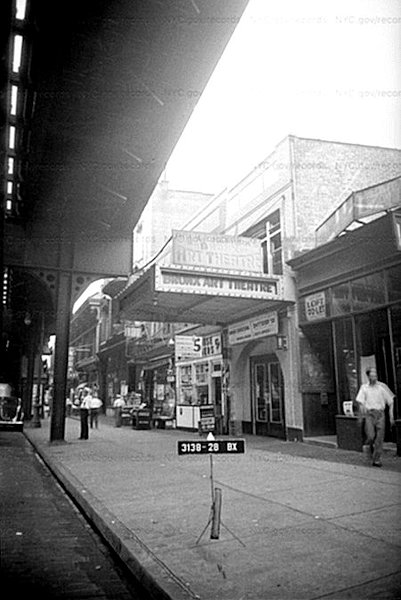
The Bronx Art
Theatre
"A YIDISHE GREFIN" |
 |
|
Museum of Family History
Visit
Us
Site Map
Exhibitions
Education & Research
Multimedia
About the Museum
Contact Us
Links |
|
The Bronx Art
Theatre
"A YIDISHE GREFIN" |
|
|
The following review was written by L. Fogelman for the Yiddish Forward newspaper and was published on December 25, 1936. Here it the English translation:
Shlomo Edelheit's operetta, "The Jewish Countess," which they are playing now in the Bronx theatre, is a musical play, which also has melodramatic content, such as in the average operettas that they play on the "Avenue." "The Jewish Countess" also has the hint of humor, as in most Yiddish operettas, and not one hint, but several at once: "The Jewish Countess," like other Yiddish operettas, also possesses Jewish melodies and a considerable bit of cantorials: She also has in her a tear and a kosher Jewish morality, a Jewish morality for both old and young; in one word, she has nothing to be ashamed of for the plays of our Yiddish "Broadway," -- for Second Avenue. And the Bronx "Art Theatre" has, to my surprise, on the stage is a considerable bit of youth, fresh, divided American youth, who speak Yiddish with American charm, a little goyish. It is interesting to watch her and to hear her. And a pleasant surprise for me was that the operetta has a lot of music in it, and just pleasant, melodic music; they sing there more than they speak; they say a couple of words and a bit with music; a speech done and sung with a song. A pleasure, as is life ... And after a pleasant surprise there were the couplets, the "lyrics": They are almost completely witty, funny, and generally successful, and you also do not have to lower your eyes to hear the couplets. Harry Schlecker, who has composed the music and the lyrics in the operetta, receives a great compliment here. In the content of the operetta, the author, Edelheit, includes many dramatic and romantic moments, which transforms it into a melodrama, which from time to time evokes a tear and, that is, incidentally, overflowing with miracles. Here you have a Jewish countess, who was once a cantor's daughter; Before the wedding, she once left her Jewish bridegroom and fled with a Christian, an officer, who later turned out to be a count.; and later, when the count died, their daughter fell in love with a Jewish student, a son of a rich American; it appears later that the American Jew is the former Jewish bridegroom of the countess; and you already can understand the ending yourself: not only did the young couple in love finally get married, but also their parents, the formerly separated bride and groom; and at the end there occurred yet an additional second wedding; and there shall be gladness in the hearts of all, the joys that come after all the troubles of the heroes. The "Pintele yid" here revolves around the central thought and main motive of the operetta, that "once a Jew, always a Jew." The Jewish heart of the countess was not cooled; it draws her back to her people, which she left because of her love.
And if you want, there is also a second
thought and a second motive that goes through the play: the
thought that love is stronger than religion, and it breaks all
ties.
The countess is played by Annie Cherniak; she behaves with such pride and swirl on stage that it feels more like the countess than a cantor's daughter. The rich American is played by Bennie Zeidman, who here sings romantic songs, cantorial numbers, and also performs in dramatic scenes. The countess' daughter is played by Lili Schechter, who is young and quite beautiful, and she stays on the stage in a pleasant way. She performs smoothly her singing numbers. Moe Zaar here is her lover; he is also young and handsome, and he also doesn't sing badly. But special attention is drawn to the young, vivacious and playful Ann Lewis, in the role of the American's daughter. She is gracious, flexible and appealing. With her agility, easy dance, with her lively, cheerful playing, she awakens an interest from the audience. She should not be neglected on the Yiddish stage. Her partner, the young Larry Gilbert, is a quite lively actor who can be well utilized under a proper direction. Ella Wallerstein and Yakob Bergreen play here with humor in the production; she is cheerful, mobile and very calm; he, as a comic peddler, is unfortunately not comical enough. Sigmund Zuckerberg plays here a cracked, hardened Baron "Fon Shtayn." Ray Schneier plays a melodramatic role of the countess' sister, in a touching way. And Abe Hart plays the role of a gentile "professor," who is entirely redundant in the play; the "professor" here does not add any reference at all. A pleasant impression is made by the young and beautiful choristers on the stage. According to this, how the audience receives in the theatre the performance and the troupe, creates the impression that both the play and the actors have a success in the Bronx.
|
Copyright © Museum of Family History. All rights reserved. Image Use Policy


