|
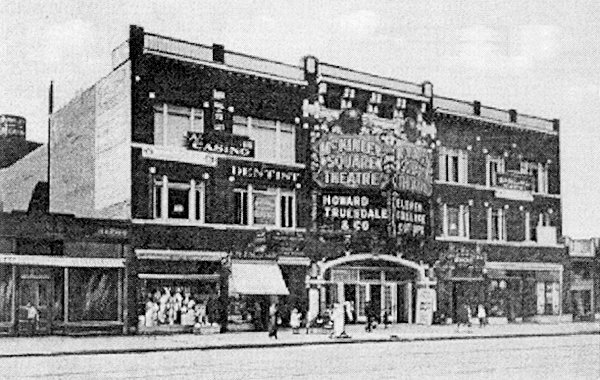
The McKinley Square
Theatre
"A NAKHT IN RUMENYE" |
|
|
Museum of Family History
Visit
Us
Site Map
Exhibitions
Education & Research
Multimedia
About the Museum
Contact Us
Links |
|
The McKinley Square
Theatre
"A NAKHT IN RUMENYE" |
|
|
||||||||||||||||||||||
|
The action is played partly in the city of Belz, in Rumania, and partly in Berlin. A Belz girl, Mirele, flees to Berlin, and there she becomes a famous actress under the name of Maritza. She falls in love with an actor, Victor, and he with her. However, Victor's mother, a rich widow, is against this match because they talk about Maritza, that she is a loose woman. Victor doesn't want to hear it. But he carries this with him under false pretenses, and he renounces her. And here the Hitlerites are attacking, and Maritz's is all over the place, because she is a Jewish child. She travels back home with a broken heart to Belz. The theatre where she had acted is, naturally, is in great trouble without her. Mirele's couisn, Alter'l, an honest young man with the authority of the rabbinate, has long been deeply in love with her. His love is inflamed even more. But Mirele is not able to forget Victor. And Alter'l, again, Esther is in love with him, the daughter of the head of the Belz community, R' Hatzkel. A three-pronged tragedy -- the eternal triangle. And R' Hatzkel, who is a widower, begins a match with Mirele, and it turns into a nasty, intriguing piece. This knipel is quickly complicated when Victor comes down to Belz. He could not forget Mirele, and he finds out that Mirele is innocent, that only a slander was made of her. Short and sweet, he marries Mirele, and Aleter'l marries Esther. * * *
From the participants the best standouts were Sadie Schoengold , Annie Lubin, Jacob Rechtzeit and Pinchus Lawenda. Sadie Schoengold (she plays Mirele, or Maritza) possesses a lot of appeal, splendor and is generally pleasant with stage virtues. Pinchus Lawenda appears as the Rev, Alter'l, and sings very beautifully and with taste, an extraordinary good singer. Annie Lubin and Jacob Rechtzeit are a couple of happy stiffs. They joke, sing, dance and turn worlds, and the audience amuse themselved deliciously. Quite nicely playing their roles were Bettie Jacobs, as Ruzhe, the Kartenvarferke; Leon Schechter, as Shlomo Badkhan; Sam Auerbach, as R' Hatzkel, Rachelle Rosenfeld, as Ester'l, and Max Lasky, as Victor, singing and playing not badly. Julius Adler plays nshksh, as Fritz the Reporter. Max Henig plays the Nazi officer Paul, and Clara [Rafalo], as the woman Johanna.
|
Copyright © Museum of Family History. All rights reserved. Image Use Policy