|
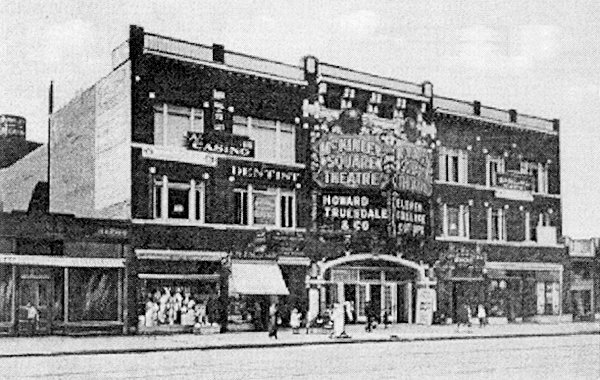
The McKinley Square
Theatre
"KINDER FUN DER ERD" |
|
|
Museum of Family History
Visit
Us
Site Map
Exhibitions
Education & Research
Multimedia
About the Museum
Contact Us
Links |
|
The McKinley Square
Theatre
"KINDER FUN DER ERD" |
|
|
The following review, written by Abraham Cahan for the Yiddish Forward newspaper, was first published on February 12, 1926. Here is the English translation:
When one sees the thing it is easy to understand why the old Kessler wanted to play it. In it there is material for a skillful dramatic actor. The following story is represented: A Jewish farmer from the Catskills has a young daughter in Russia. She needs to come here with a grandfather. But she was detained there, and then a pogrom occurred. Finally she comes over. It is a joyous event. The farmer and his wife are happy, overjoyed. Gradually, however, they begin to feel that their happiness is disturbed: in the pogrom the girl became ruined. She needs to become a mother. The family is in despair. The cloud of tragedy hangs over the simple but good and honest family. The girl has her child, and in a minute of questioning, when he is overwhelmed with shame, the farmer asks for an unexpected thing: he strangles the baby and buries it in the woods. The secret lies on his conscience like a burden. It does not let him rest, wherever he stands and wherever he goes, he thinks about it. The ignorant, honest man cannot withstand the secret that keeps him from having a shier. He consults with the rabbi of the village, who is also the cantor and teacher of his son. The rabbi comforts him. He assures him that God will not punish him. Yom Kippur comes and the farmer is afraid to go to shul due to his great past. The rabbi, however, assures him that God will forgive him his sin; that the Lord of Hosts may have mercy on him. The farmer goes to shul. He prays with his entire heart. As he is the most important patron, he is honored by taking out the Torah scroll. And here is exactly what goes wrong: the Torah scroll falls out of his hands. The superstitious person is sure that this is a sign from above -- the finger of God. To throw down a Torah scroll! This in itself is a terrible sin. This will never be forgotten. He suffers a shnier. He frightens himself. His heart is torn with conscience and from trembling. There is also a novel in the play. The farmer stops a phonograph salesman for a while, and he falls in love with the girl. He has no idea about the past. That she's a baby buried in the woods -- he has not the slightest suspicion of such a thing. But send the Lord of Hosts to an intriguer in the play. The Catskills rabbi has a daughter, and she is in love with this same young man. She has a long tongue and a bad will. She loves to peek at strangers' plates and tease another bride from her groom. Especially when the groom is none other than Dave Muralvin, the salesman, with which she is mortally in love! Luckily for her, and for the misfortune of her competitors, her father, the rabbi, has to write a story about a higher rabbi, and she, the intriguer, has to copy the letter. In short -- she tells the salesman the whole story, and the hero grabs his suit and drives away. Matchmaking out! The tragedy reaches its climax: the farmer hangs himself. However -- There is no such thing as "but" in such a case -- the hero revives him, that the hero had a baby as a result of a pogrom. She is not guilty. She is a martyr, and instead deserves compassion and respect. In short -- he comes running back, and the intriguer to spite, marries the heroine. The theatre audience goes home with a comfort in their heart.
A melodramatic story, as the reader
sees. However, it has a strong, dramatic possibility,
and one can easily understand that David Kessler would
want the main role and make it a strong thing.
Joseph Kessler, naturally, is an actor of an entirely other sort, but he does his duty with seriousness, and the production is interesting to the audience. The role of the girl is played by Henrietta Schnitzer. She acts well, and several moments very strongly. Also ... playing is Lisa Silbert, as the farmer's wife. The others perform in their role reasonably. But overall the performance is impressive. Bennie, the farmer's son, was played by Hymie Prizant; as the rabbi -- Adolf Lianski; as Muralvin -- Harry Tchaikowsky; as the Intrigant -- Celia Pearson. The play is "trimmed" with humor, and in many places the theatre bursts with laughter from a genuine Libin joke. The piece contains many markers of Libin's brilliant talent in particular.
|
Copyright © Museum of Family History. All rights reserved. Image Use Policy