|
|
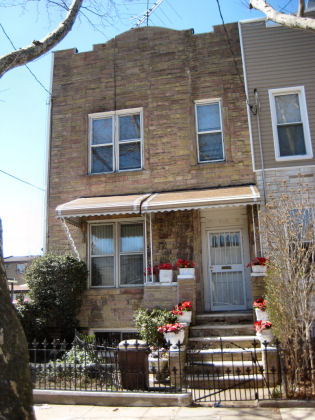
Berriman Street is a street in the East New York section of Brooklyn.
The neighborhood was the settling grounds of Jewish refugees seeking to
escape from the tenements of the Lower East Side of Manhattan in the
early 1900’s. My mother was born on Berriman Street. As a child my
family went to my grandparents’ - who still lived on Berriman Street for
the high holidays. A block away from my grandparent’s house was Talmud
Torah Ohav Zedek better known as the Berriman Street Shul. As years
have gone by I have been to many different types of shuls in various
socio-economic neighborhoods, but for me nothing matches the experience
of the holidays in the Berriman Street Shul.
This was a shul founded by my great grandfather in New York, but if you
didn’t know better you could have believed it was located in a shtetl in
Galicia. In the fifties and early sixties when I spent my holidays
there, it was populated by refugees from Galicia including many
Holocaust survivors.
During that time I was living with my parents in Kew Gardens Hills -
where the Jews who wanted to move from the changing neighborhoods of
Brooklyn moved to. |
|
We went to the Jewish Center of Kew Gardens Hills, one of the premier
institutions of the Conservative movement. There the services were led
by the prominent rabbi, I. Usher Kirschblum and famous cantors like
Jacob Koussevitzky and Charles Block. The Hebrew of the Jewish Center
was the standard American accented Ashkenazi Hebrew. The Hebrew in
Berriman Street was the Galician-accented Hebrew of the Old Country.
The sermons in the Jewish Center were in English by a polished public
speaker. In Berriman Street all speeches were in Yiddish (which I
didn’t understand well). By the fifties, when I was born, Berriman
Street did not have a rabbi and for the holidays they would hire a Baal
Tephilah, not a cantor.
By all indications the Jewish Center where I went to Hebrew School and
had all my friends should have been the more desirable place for a young
boy growing up in NY in the fifties. Yet for me nothing could have been
further from the truth. I absolutely loved going to Berriman Street for
the holidays and besides being with my grandparents the shul was the big
reason why.
I loved how the characters of the shul could have dropped out of an
Isaac Bashevis Singer novel. There was a story about everybody and as a
young boy I relished in these stories. Honors were auctioned off and my
Great Uncle Yossel was the auctioneer in his delightfully accented
Yiddish. Each year, my father bought my grandfather the Levy aliya on
the first day of Rosh Hashanah. It usually ended up costing him about
five dollars. For the first Rosh Hashanah after my Bar Mitzvah my Uncle
promised to buy for me Maftir. It ended up costing him twenty-five
dollars. He was furious because he suspected somebody was bidding it up
in order to force him to pay more, knowing that my Uncle had promised it
to me.
In the Berriman Street Shul the congregation prayed with a fervor and
fear of G-d never seen in the Jewish Center. When Shema Koleinu (Koyleine
in Berriman Street Hebrew) came around the elder refugees and survivors
were praying for G-d not to forsake them in their old age. Tears from
the women’s gallery and the trembling of the men greatly affected me as
a young boy.
In the early sixties the East New York neighborhood started to change
and the world of the Berriman Street Shul was dying. By 1964, my
grandfather had died and my grandmother was the last white person on her
block. There was nobody around to maintain the shul and it was sold to
a church. My Grandmother moved to Queens and my family started to go
exclusively to the Jewish Center of Kew Gardens Hills for the holidays.
There we were part of the hundreds of Congregants who listened to
powerful sermons and wonderful Cantors with prominent choirs. For me,
the holidays were never the same. The passion and fervor of the
congregants for the prayers in Berriman Street were unmatched. I missed
the flavorful Yiddish of Uncle Yossel’s auctioning and the crying chants
and melodies of the Baal Tephilas.
From there, my journey continued and I followed the path of many of the
New York Jews of the times. I got married and moved to the elegant
suburb of Great Neck in Long Island. We joined Temple Israel of Great
Neck led by the scholarly Rabbi Mordechai Waxman and for the holidays I
was enchanted by the masterful chazanut of the Chief Cantor of the
Israeli Army, Arie Braun. As much as I enjoyed listening to them, for
me it was still not quite Berriman Street.
|
Today East New York is experiencing a revival as it is being rebuilt
and re-emerging after decades as a crime ridden neighborhood. While
it is a pleasure to see the neighborhood revitalized I am afraid it
will never be a Jewish neighborhood again. Kew Gardens Hills is now
a Haredi neighborhood and the Conservative Jewish Center with it’s
magnificent sanctuary is struggling to survive and it’s just a
matter of time till it is taken over by some Orthodox congregation.
Temple Israel of Great Neck is still a leading Conservative
congregation but is also drastically losing membership.
Now I live in Roslyn, Long Island. Last week for Kol Nidre I went
to Chabad with my cousin who used to go to the Berriman Street Shul
with me. We rushed to get there in time for Kol Nidre. As we
walked in something astonishing was happening on the bimah. There
was an auction for who would hold the torah’s for Kol Nidre. My
cousin and I were enthralled. Instead of Uncle Yossel yelling out
“ein, tzveih, drei” there was a kind Persian man yelling out “achat,
shtaim, shalosh” Instead of the honors going for five to twenty-five
dollars, they were going for twelve to sixteen hundred dollars.
The cantor there had a beautiful voice. He sang the heart rendering
melodic chants of the Baal Tephilas of Berriman Street. My cousin
and I gleefully sang along. My cousin’s young son who never
experienced a service other than Reform chaverim remarked how he
absolutely loved it and wanted to go back. |
|
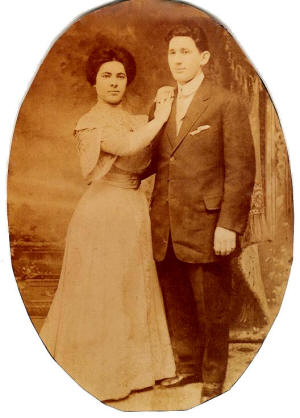
Engagement photograph
of Steven's grandparents,
Fanny Endlich and Samuel Hoffeld,
East New York section of Brooklyn,
1911
|
I think the place we really wanted to take him back to was Berriman
Street. There is no longer a shul on Berriman Street but the piety and
authenticity has been relocated into the hearts of the young boys and
girls who had the privilege of davening there. Our offspring are still
looking for that experience that we enjoyed in our youth in the Berriman
Street Shul.
|