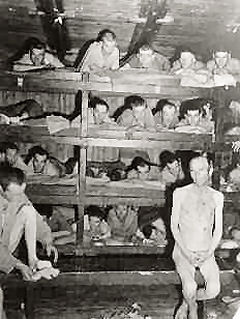
April 1945
The camp was operating on a day-to-day
basis, food was a rare occurrence. The warehouses were emptied by the
Germans into big trucks and hauled away daily. The kitchen was not
functioning every day. Every second day, we receive a bowl of soup and a
slice of bread. But who cared? The bombing and the loud shelling were now
steady without interruption. We were going to be liberated any day now! At
night we could not fall asleep because of the excitement. What have these
Germans got planned for us; maybe they will destroy the whole camp just
before the on-coming Americans enter this hell and see the dead bodies
piled up by the thousands. They might want to destroy the evidence.
April 11, 1945, 8 a.m.
Russian P.O.W.s come running into our
children's Barrack Block 8 and ordered all the kids to get on the floor
adjacent to the exterior wall.
Our bunks were quickly removed from the
room and they opened a trap door in the middle of the room.
A number of P.O.W.s lowered themselves with
ropes below the floor and were bringing up machine guns, anti-tank guns,
and grenades by the buckets. We could hear them yell in Russian, "Careful,
these grenades are no joke. They are all alive, be careful!" Our hearts
were pumping like crazy; what did that all mean?
After about 15 minutes, the shooting
started and it sounded like we were being attacked; the smaller children
were crying now, and we, the older ones, were scared to death. We heard
Franta's voice: "Nothing to worry children, the shooting that you hear is
from our side: they are destroying the guard posts and the SS that are
within them. Within a few hours we will be able to really say that we are
free." We were all relaxed and somehow a quiet moment came over us and we
all burst out crying without being able to stop.
After about two hours of shooting the
loudspeaker in the barrack makes an announcement: "We are Free! Our boys
control the camp and the surrounding villages." We all jumped from the
floor; we hugged each other and cried some more
"We are Free! We are Free!"
At about noon time the loudspeaker calls
again. Attention! Attention! This is your Lagerfuhrer speaking. I
just received a call from the SS chief in Weimar to fulfill the order to
start destroying the camp.
I told him to go to hell. We are in charge
now! And you can go, and blow yourself up! Imagine, we found out from the
reports that all of Buchenwald Camp was undermined and we were supposed to
be blown to pieces before the surrender of the camp to the Allies. We were
relieved that we were saved from destruction.
April 11, 1945, 4 p.m.
American army tanks entered the camp
through the rear of the camp wire fences. The roar of the tanks made us
shiver from happiness; the tanks proceeded to roll towards the Apell
Platz next to the main entrance. Everybody was running towards the
American liberators, hugging and kissing them; they were practically
tearing them apart. Everybody wanted to touch them and embrace them.
Tears were running freely from everyone,
including the big strong black Americans. People were dancing and
screaming: "We are free! We are free!" American planes were overhead
dropping balloons with the American flag attached to them. The skies were
full of parachutes with food supplies dropping all over the place. What a
sight! People were going wild tearing the supplies apart and having a
feast. Singing and crying at the same time, without realizing that their
stomachs were not used to that much food.
More trucks entered through the main gates
with G.I.s in full gear, most of them black and Jewish men. They just
stood there in amazement, seeing people acting like hungry vultures.
Within minutes they realize that these vultures were professors,
scientists, doctors, lawyers, writers, poets, singers, rabbis, cantors,
businessmen, tailors, plumbers, electricians, carpenters, but the German
Nazis, with their brutal actions against the Jews, managed to make them
all look alike. Furthermore, history will show that such brutal behaviour
from a civilized people was never seen before, and may never be seen
again.
The soldiers were handing out their rations
to the crowd, including chocolate bars that we had not seen for a long
time. They tasted like something from heaven.
We were having trouble communicating, since
very few of us spoke English. A few Jewish G.I.s that spoke Yiddish were
standing with a group of Jewish men. Survivors. You could hear the crying
from the individuals giving them the reports. They killed my children, my
brothers and sisters, the whole Shtetl. They were all lined up and
shot like animals in the woods of our little town, buried in a mass grave
that they had to dig for themselves. One horror story after another. The
G.I.s couldn't take it any more; they walked away with their faces swollen
from tears.
In the meantime, the people that ate too
much were getting sick, they just lay on the ground and nobody cared,
there was no order yet in camp; everyone was out for themselves.
The number of sick was rising, you could
hardly move on the Apell Platz where everyone was rejoicing the
liberation, and there was no control over this mass of sick and hungry
people. After a couple of hours of celebrating our liberation, we were
told to return to our barracks and wait for further orders from the new
management. As we all left the Apell Platz it looked like a
battlefield. People in the hundreds were lying on the ground, some were
dead, some were sick, and some of them just asleep.
The main kitchen was opened, and food
supplies were being brought in by the truckloads. Within a few hours food
was being distributed and people were so wild and hungry that they
attacked the food carriers and dove into the large food containers
head-first, just to satisfy their hunger. They ended up sick from too much
food, and were all carried away to the hospital screaming with pain. Back
in our block 8, the children were singing and dancing, celebrating our
liberation. Our leaders from our barrack told us about all the ammunition
that was stored in our barrack by the underground special group assigned
to bring small quantities of gun powder and other parts of ammunition,
that was all later assembled and stored in our barrack for the final
moments to liberate us before the Germans could do more harm. And they
assured us that we would all go back home as soon as the war was over.
April 14, 1945
General Eisenhower and his staff arrived to
inspect the camp in Buchenwald. We all ran out to greet them as they
walked in through the main entrance gates. General Eisenhower and staff
were shown the great piles of human bodies, piled like lumber, stacked 10
feet high.
They just stood there in amazement, their
faces turned colours. General Eisenhower and his staff removed their
helmets and stood there in a one minute salute for the dead.
"Who would do such a thing to human beings?
I can't believe what I see." Eisenhower said He turned to his staff and
gave them an order: "I want the whole city of Weimar, all men, women, and
children, brought in to see this tragic site." Again, he saluted the dead
and hurriedly walked away from the mass of corpses toward the main gates
saying, "I had enough, I think I've seen enough today."
The next morning we saw thousands of men,
woman, and children from the city of Weimar, which was only about 10km
away, being herded into Buchenwald through the main gates. They were then
shown all the corpses and all the killing facilities in Buchenwald, some
of them couldn’t take it any longer, some fainted, some of them were
holding their hands over their eyes, but the G.I.s removed their hands and
told them: "Look, look good and never forget what you have seen here
today. Maybe you will be able to tell your children, and grandchildren,
what your beloved Fuhrer Adolf did to mankind in the twentieth century. In
your fatherland, and all over Europe."
When the exhibition was completed, they
were all assembled on the Apell Platz, where Rabbi Shachter, the
Chaplain of the American first and second division of the liberation Army,
spoke to the German population of Weimar from the top off a military
truck. In his hand, Rabbi Shachter held a young Jewish boy who looked
about 6 years old.
He raised the child for everyone to see and
with his great voice declared: "This child was your Fuhrer's greatest
enemy! Can you imagine a greater enemy?" he asked.
Their faces were stiff, frozen and ashamed,
being part of this devastation. Rabbi Shachter continued and said, "This
child will be a witness to your persecutions, and also a witness, that
over one million Jewish children never made it." The Germans were standing
with their heads bowed and murmuring to themselves. We never knew about
these atrocities. Some couldn’t hold back their tears, they were crying
openly. We, the survivors, were observing this show of emotions and
thinking quietly. How can a people stoop so low and deny that they knew
what was going on under their noses, only 10 km away? Truck drivers
delivering supplies to Buchenwald daily, plus the foremen in the
ammunition factories, were all Germans from the once great city of Weimar.
Since 1939, Buchenwald had been a
slaughtering place for anyone opposing the Reich. German people from towns
and villages were brought here and finished off, never to be seen again.
And now they were confronted with reality and had the guts to say "We
didn't know".
We had no sympathy for them, they rather
looked very low in character to us. The child held by Rabbi Shachter is
Rabbi Lowe, now Chief Rabbi in the State of Israel.
The show was over and the people were told
to disperse, except for some men and women that were selected for removing
the thousands of dead bodies lying all over camp. The dead bodies were
then gathered on a truck and taken to the woods, where they were all
buried in a mass grave.
All Jews were invited by Rabbi Shachter to
attend services and to eat Matza, since it was Pesach Sheini
that day. The second Pesach, for Jews that couldn't observe the
holiday of Pesach at the proper date. Rabbi Shachter brought Matzos
and distributed them to every one. Rabbi Shachter started to deliver his
sermon, when suddenly he was interrupted by a fellow prisoner. When he
heard the Rabbi say, "We know what you have gone through" The man screamed
and said: "No one, but no one, can dare say that he knows what we went
through unless, he or she was there! Only they can say, I know what you
went through!" He continued at the top of his voice with quotes from the
Torah and other scriptures. He was no plain ordinary every day Jew. He
spoke with authority. "Why did G-d forget about his children? And we were
devastated, just because we are Jews?" he continued. "Before we make a
blessing and eat this Matza. We want a Din Torah with the
REBONEH SHEL OLAM (Hold Court with the All Mighty): Why? Why the
little children?
They didn't have a chance to sin yet? Why
so many thousands of true dedicated Talmidei chachomim
(Jewish learned men), that were sitting and learning JOMAM VLAJLA
day and night? You can take your matzos back to America. I don't want
them, as far as I am concerned. The rest of you: you are free! You can do
what your heart desires!"
Rabbi Shachter did not interrupt the man
and he let him finish. He moved his fists towards his heart and said, "Chotosi
Uvisi Pushati Lefonecha: Please, may I have your forgiveness?" The man
raced up to the Rabbi and embraced him for a while. The rest of us just
stood there in silence, and our tears did the talking. After that scene we
all decided to have some Matzo anyway. We made the blessing of ACHILAT
MATZOT in unison. I am sure that this blessing was heard in heaven,
and all the Angels answered Amen.
The assembled crowd dispersed and all the
children were gathered and were taken to other quarters outside the camp
walls, into the old SS officer barracks, where we spent our stay until we
departed for Czechoslovakia on our way to our cities and villages.
next >>