Bergen-Belsen (or Belsen) was a Nazi
concentration camp in Lower Saxony in
northwestern Germany,
southwest of the town of Bergen near Celle.
Originally established as the prisoner-of-war camp
Stalag XI-C, in 1943 it became a concentration camp
on the orders of Heinrich Himmler, where Jewish
hostages
were held with the
intention of exchanging
them for German prisoners-of-war held overseas. |
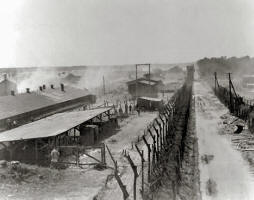
A view of the
Bergen-Belsen concentration camp after the
liberation of the camp. Bergen-Belsen, after April
15, 1945.
Courtesy of
NARA.
|
Later still the
name was applied to the displaced persons camp
established nearby, but it is most commonly
associated with the concentration camp it became as
conditions deteriorated between 1943-1945. During
this time an estimated 50,000 Russian
prisoners-of-war and a further 50,000 inmates died
there, up to 35,000 of them dying of typhus in the
first few months of 1945. |
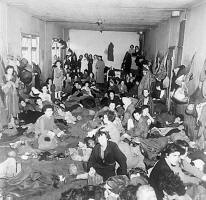
The Liberation of
Belsen Concentration Camp April 1945: Women and
children herded together in one of the barrack
blocks. - 17-18 April 1945.
From
Wikipedia. |
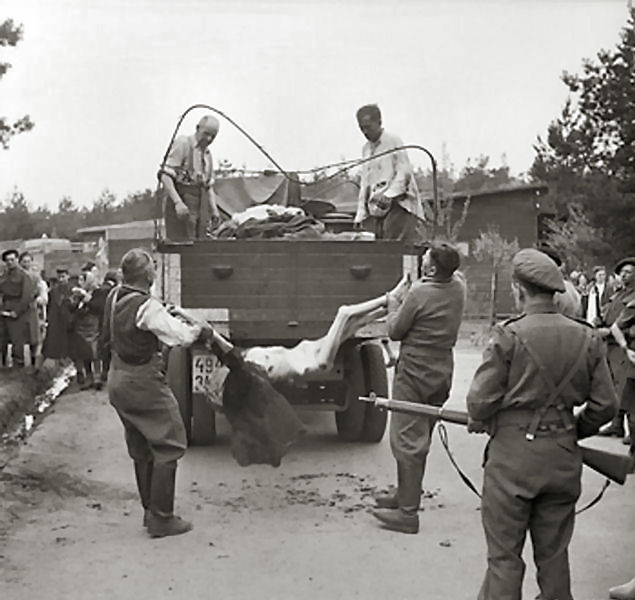
The camp was liberated
on April 15, 1945 by the British 11th
Armoured Division. Sixty thousand prisoners
were found inside, most of them seriously
ill,
and
another 13,000 corpses lay around the camp
unburied.The scenes that greeted British
troops were described by the BBC's Richard
Dimbleby, who accompanied them....
|
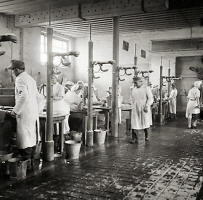
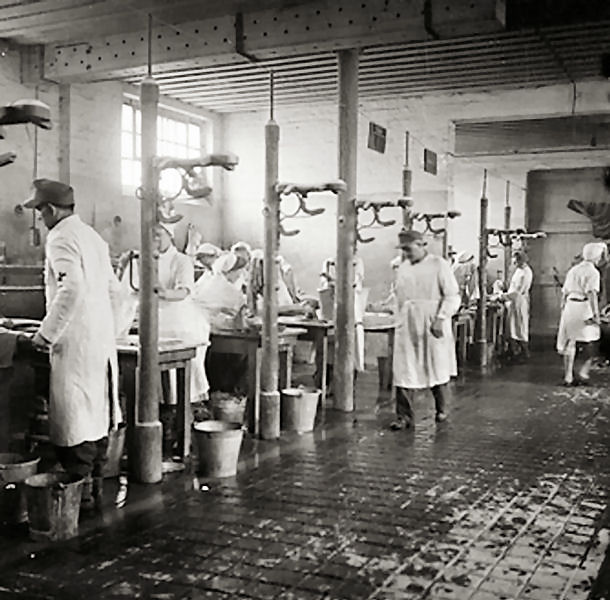
Scene inside the
cleansing station, nicknamed the "Human Laundry",
which was housed in a former stable for cavalry horses at the newly
established hospital for Belsen inmates.
The photograph shows some of the sixty tables, each
staffed by two German doctors and two German nurses,
at which the sick were washed and deloused.
- 1-4 May 1945.
From
Wikipedia.
|
|
"...Here over an acre of ground lay dead and dying
people. You could not see which was which... The
living lay with their heads against the corpses and
around them moved the awful, ghostly procession of
emaciated, aimless people, with nothing to do and
with no hope of life, unable to move out of your
way, unable to look at the terrible sights around
them..." |
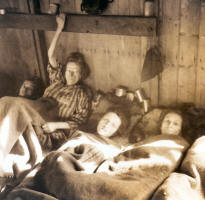
Female survivors
lie in bunks
inside the barracks of the
Bergen-Belsen concentration camp.
From the
USHMM.
|
"...
Babies had been born here, tiny wizened things that
could not live ... A mother, driven mad, screamed at
a British sentry to give her milk for her child, and
thrust the tiny mite into his arms, then ran off,
crying terribly. He opened the bundle and found the
baby had been dead for days.
This day at Belsen was the most horrible of my
life." |
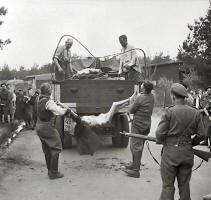
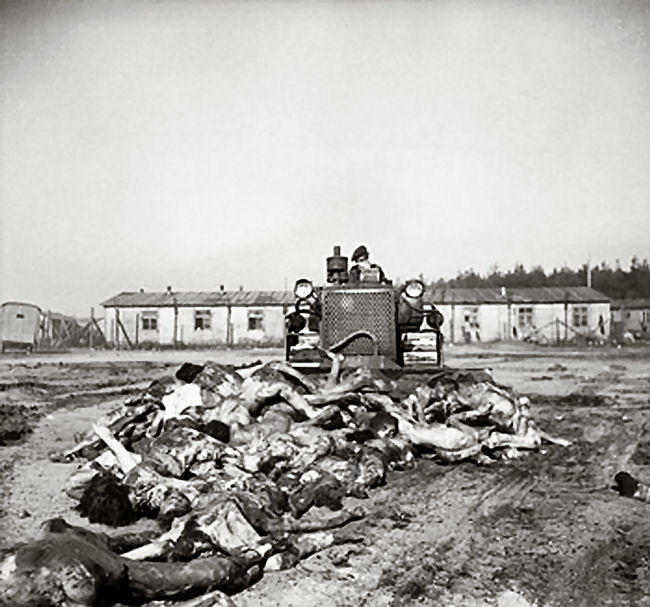
The Liberation of
Belsen Concentration Camp April 1945: A British Army
bulldozer pushes bodies into a mass grave at Belsen.
- 19 April 1945.
From
Wikipedia. |
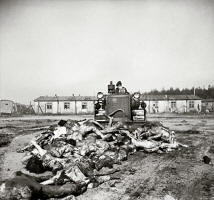
The Liberation of Belsen Concentration Camp April
1945: A British Army bulldozer pushes bodies into a
mass grave at Belsen.
- 19 April 1945.
From
Wikipedia. |
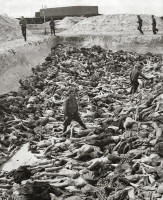
Mass Grave
3 of the Bergen-Belsen concentration camp,
photographed by a British soldier after the
camp's liberation in April 1945. Dr. Fritz
Klein, a German doctor at the camp, can be
seen in the foreground standing amongst the
corpses. The Small Arms Range is visible in
the background, April 23, 1945. From
Wikipedia.
|