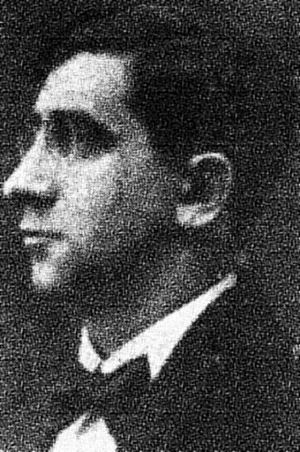
|
When Aneta Finkel's troupe
disbanded, K. made a connection with Meyer Schwartz, and
not having enough actors, especially actresses, took K.
up onto the stage with Sarah. The troupe disbanded
soon and both went over again to Rosenblum's troupe in
the town Pantshe. Returning with the troupe to Galatz,
they became bergenumen for Goldfaden, but as
there was not any rent to pay, and by them there was
born a child, K. went out of the troupe, away to Braila,
where he entered into a coffee house as a singer of
songs. Also his wife later stood by him as a song
singer, and then they both went to Kolomea, Galicia,
into Tanentsap's troupe. Again they were, due to
difficult material conditions, forced to leave the
troupe and leave to return to Romania, where they
themselves put together a small troupe that wandered
across coffee houses, summer gardens, where they
entertained the audience with songs, couplets and small
scenes. They became popular, and they were invited to
Lemberg, Galicia, where they performed with success and
became engaged to act in vaudeville in Vienna, where
they remained for four years. Then they performed in
Budapest, Hungary.
In September 1906 K. was
brought by Yosl Groper to America, where he and his wife
performed with Levy in the "People's Music Hall", and
after acting for several years in Yiddish vaudeville,
they became engaged to Mike Thomashefsky in
Philadelphia, where they acted for two seasons, then in
Newark's "Metropolitan Theatre".
In 1914 K., together with
his wife and daughter Tina, who also became a Yiddish
actress, went to Europe and guest-starred in London's
"Pavilion Theatre", in Warsaw with Kompaneyets, in Lodz
with Lipovski, Bialystok, et al., then played in
Bucharest with Mordechai and Chaim Meir Segalesko, and
Sholom Simovitsh with whom also traveled to
Constantinople, Turkey.
About K.'s performing in
Romania, Jacob Botoshansky writes:
"In that time the troupe of
Kanner-Seglesko aropgefaln to Falticeni, which had
staged several productions. A troupe with a pretty,
little actor is there. Kanner alone was .... rist
and courtesy. He performed as an elegant comic and he
bore the tails with less grace, and he had plainly
brought forth the words politely.... It wasn't long
before Leopold Kanner returned from the United States,
and he had both money and a name. He was a very fine
character-comic. He had a im with grace. He even
possessed elegance. Also he had never not seen a Yiddish
actor who wore a frock so well as Kanner had
demonstrated. He was somehow higher than Mitlvuksik,
Brown. He had round, olive eyes and also alone was
hibshlekh keylekhdik. He had then considered easily,
and he was very boygzam. I have seen him play the
rich uncle in "Borg mir dayn vayb", and I had until then
not seen such an elegant, older man on the Yiddish
stage. He also acted fine in tragi-comedies. I had at
times seen him in a play "Far riamantn", acting in a
tragi-comical role, and he had the audience shed not a
few tears as they laughed. In kaftan roles, he was worse
than in tails".
Botoshansky also remarks
about a second time when he happened upon K.'s
performance in Bucharest. The troupe was under the
direction of Kanner-Goldenburg. It was during the First
World War, and in Romania there were many desertions by
those who hadn't any desire to serve in the Russian army
under the despised Czarist rule:
"The Yiddish theatre then
was quite full of Russian Jews and Jewish actors who had
served, and they had said, pieces of gold. ... The
troupe had performed operettas and melodramas. In the
operettas the Kaners were given tickets/cards [acting in
the main roles], in the melodramas Goldenburg had acted
in the main roles, but the Kaners had acted and shared
with him the success".
As a non-American citizen,
K. could not return to America when Romania joined in
the War, and he became taken into the military, and
there he became sick from fleck-typhus, and in 1919
passed away in Bucharest.
Sh. E. from
Sarah Kanner, M. E. from Chaika Laznik.
-
Yankev (Jacob) Botoshansky --
Tsvishn forhang in leyvnt, "Di prese", Buenos Aires, 30 August
1935.
-
Jacob Botoshansky -- L.
Kanner un
leon berger, "Theatre", Buenos Aires, October-November 1941.
-
Jacob Botoshansky -- "Di
lebnsgeshikhte fun a yidishn zhurnalist", Buenos Aires, third
part, 1942, pp. 53, 136-37.
|