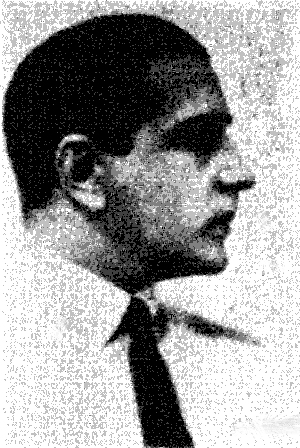
Ossip Runitsch
|
|
|
Runitsch
was born in Peterburg [St. Petersburg], Russia, wherein
his parents, assimilated Jews, moved on to Vitebsk. Due
to this, his two brothers were already actors, and their
father wanted to make him an engineer, but the actor
Pavel Orlenev heard him once declaim at a student ball,
spoke to him strongly about becoming an actor, and he
was taken into a troupe. A season later Runitsch was
engaged to Bilayev, and from there he was snared by the
director and regisseur Sigelnikov, for whom he played
for five years.
Being a delegate at the Artists'
Conference in Moscow, he became known here to
Protazanov, one of the first pioneers of Russian silent
films, and through him he was engaged to play in the
film, "Milkhome un sholem (War and Peace)," by Count
Tolstoy. From there Runitsch often became a participant
as a main role player in the Russian silent films and
became extremely popular and beloved across the entirety
of Russia. At the same time, however, he further played
on the Russian stage.
After the Russian Revolution Runitsch left Russia and
participated in silent films in Germany, and then
in Italy, from where he came to Riga, where he played in
the Russian drama and went into the Russian theatre,
guest-starring across Poland, Romania, Lita (Lithuania),
Czechoslovakia, Yugoslavia, and other countries, until
he returned to Riga and crossed over to the Yiddish
stage, where he performed on Ts. A. in "Azev,"
"Der
|
antisemit" by Anri
Bernstein, "Dovid Golder," "Der veg tsum glik" ("Di
kirkhn-moyz"). Runitsch also played on the Yiddish
stage in Kovno (Lithuania).
In 1939 Runitsch
came to South Africa, and there performed in Yiddish
in "Dovid Golder," "Der atestat," Friling in
September," "Dos fremde kind," and "Kreutzer
Sonata." In the more recent years Runitsch was the
main regisseur, directing the operas in the opera
season across South Africa.
On 6 April 1947
Runitsch passed away in Johannesburg, South Africa.
A large audience, Jews and non-Jews from the
intellectual world, laid him to his eternal rest.
Cantor Israel Alter said the appropriate prayers,
and the speakers were B. Gershman, M. Siegel [sp],
chairman of the Chevra Kadisha, and the African
artist Gideon Ross [sp].
During his playing
Riga, the Riga Yiddish press wrote about him:
"Ossip Runitsch with his imposing and elegant
appearance, he literally lights up the stage. A high
stage culture radiates from his playing, a rare
aristocratic nobility and intelligence. Ossip
Runitsch is not a real stage figure with which he
starts out a class above the rest of the ensemble.
Ossip Runitsch, the good, ruminating artist
with his fine attitude, imposing manifestation, tact
and understanding, the appearance was not important.
Ossip Runitsch was a real European figure, natural,
not forced, with an elegant manner, as one sees on
the great scenes and that are so rarely manifested
on the Yiddish stage. With Ossip Runitsch, the
Yiddish theatre he did not appear as only a
prominent state artist, but also a teacher and
creator of an actorial environment."
And the
Kovno Yiddish press writes:
" Runitsch is an
actor with routine and with great taste. His every
touch and turn is measured, and his silent movement
is a spotlight, which throws light on the
characteristic of his, Runitsch's, shaped type.
Runitsch is very smart and practical. He gives the
bank director (in "Der veg tsum glik"), the change
that grows in the director's role as his secretary,
"Di kirkhn mayzl," you can feel it. There are many
lyrical moments in the comedy, mainly in the 2nd and
3rd act, which Runitch plays especially well and
with originality.
Ossip Runitsch in the role
of the bank director and Baron Ulrich
And
about his activity and life in Africa, "The African
Yiddish Newspaper" writes:
"Unfortunately, the South African Jews have a
limited understanding of true art, and the
fragmentation of the local Jewish dramatic forces
did not give him the necessary encouragement to
devote his great talent to the Yiddish stage here.
It must be stated that the Afrikaans theatre circles
have recognized this great talent of Ossip Runitsch
much more, and with his management and direction
have performed many plays from Runitsch's
repertoire, translated into Afrikaans and enriched
their national culture. ... Besides his genial,
artistic talent, he had a very noble character and
made himself very popular with everyone who came in
contact with him. He approached his students and
actors with paternal love and affection, and he
earned great respect and admiration from them."
Boris Gershman writes:
"Perhaps thirty
years back: Ossip Runitsch on the high levels of his
success. Odessa. Women throw themselves under the
horses of his carriage. They wanted to die for him.
He is a prince in appearance, a deified artist. with
attractive and prominent features. Smart and lively
eyes. It shows the character of nobility and
culture."
And Y.
Charlash writes:
He was still full of energy,
bubbling with initiative and plans, and he would
surely have provided us with many more aesthetic
pleasures if he had lived. ... Ossip Runitsch was
through and through of the arts. Not only as an
actor and a regisseur and a theatre-teacher, but
also an enormous lover and admirer of the theatre.
And a great connoisseur of theatre, about the
history of the theatre styles, about the history of
costumes and furnishings of various eras, and in
various countries. Also a great lover of every form
of art -- besides the theatre. ... Runitsch
was also a first-class storyteller. With his rich
and juicy language, with the logical and meaningful
gestures, with the modulation of his melodic voice,
with the imitation of various people, he made every
story and every description vivid, interesting and
exciting. And when he had something to tell --
another life full of such development and
experiences, as he went through it. In addition, he
was a great and diligent book reader. ... Runitsch
was a proud man, and physically strong and big. He
was a very calm man and never raised his voice. It
turned out that it would be completely impossible to
knock him out with full balance. How noble and quiet
and without any troubles he bore it here during the
eight African years -- first the burden of
oppression, later of overworking oneself, and at
different times of petty, helpless and disgusting
Philistine intrigues on the part of many worthies
against him. "
Sh.E.
-- L. Mirkes (Mark Razmuni) -- Ossip Runitsch
der melekh fun di "shatns afn vand" un zayn veg tsum
Idishn teater, "Batog," Riga, 7, 8 September 1932.
-- (--) -- Ossip Runitsch, barimter artist un
rezshisor geshtarbn, "Afrikaner Idishe Tsaytung,"
Johannesburg, 10 April 1947.
-- Boris
Gershman -- Nito mer Ossip Runitsch !, dort.
-- Y. Charlash -- "Ibergerisn dos lid," dort.. |
|
|
|