|
 |
|
We were given
two pails, one empty and one full of water. We did not know the
intended use of the empty pail. After the train started moving
and the water spilled, we poured from the water bucket into the
empty bucket. Several hours later, having no alternative, men
urinated through the slats of the cattle car. The resistance of
the wind from the movement of the train caused the urine to blow
back onto me and others who attempted to relieve themselves in
this manner.
At first people drank liberally, in the hot and
uncertain conditions of the closed car. I remember that when
refilling empty juice or milk bottles with water, mothers were
asked to limit their babies’ consumption. Instinctively the
mothers would try to take more than was needed for the moment.
Under the best of conditions small children are always thirsty.
These conditions only increased their thirst. |
Within several hours we
emptied the second pail of water back into the diminished first pail.
This provided a solution for the women, children, and elderly who could
not use the slats on the side of the cattle car. Women formed a circle
around those using the pail, shielding them to protect their dignity.
The first crucial decision in this abyss we had entered
was made without the benefit of previous experience. During these three
days the train stopped two or three times for water. Wehrmacht
guards shouted that we should empty the pails and refill the water
buckets.
While at the water pump, the men learned that people on
the other cars had made a hole in the floor to be used as an alternative
to the pail. They urged everyone to do the same. This resulted in our
having the use of two pails for water. They had a choice to make. Should
we fill both buckets with water or take the time to clean one properly?
A man had to decide in a split second for everyone on the train whether
to have two unclean buckets of water or have only one dirty bucket of
water and take the time to clean the other hoping there would be time
enough to fill it.
If the decision was made to fill only one pail and
scrub the other perhaps there would be no time to fill this bucket with
water. If they filled the bucket without cleaning it they would have one
clean and one tainted bucket of water. They in fact cleaned the second
bucket and had time to refill it.
At the next stop, the pails would not have been used
for human waste and therefore we would have a second pail of cleaner
water. The acumen of these men resulted in the survival, to the train’s
destination, of all the people on
When the hole was carved we had a solution to one
problem but created another. The noise of the cold wind blowing into the
train was harrowing. We put the pail on top of the hole, only partially
solving the problem, for it was not airtight.
There were discussions among the Orthodox men regarding
the religious practice of washing one’s hands before putting on
tallicim and tefillin. Another decision had to be made,
whether to use the scarce water of this purpose or to disregard the law
and save the water for drinking.
In the train, people tried in vain to lie down and make
themselves comfortable on the floor. Those who had no place to lie
waited until someone got up and then took his or her place. By the
second day, conditions were worse; human waste was left exposed, people
vomited, the odour was nauseating. Some fainted and cried bitterly, a
few prayed in silence, hoping for a miracle. For the elderly and the
restless young, these conditions were extremely difficult.
We made what little food that we had last for the two
nights and three days that we had been told we would be on the train. We
knew that something was wrong, that we were not being told the truth
about where we were being taken. They promised us that we would be kept
together and would work.
There were enough men on the train for a minyan.
Normally, a man took his tallit and tefillin bag when
going out of town. The Germans told us to take the most precious things
on the train—and tallit and tefillin were often passed
down from generation to generation. They were precious articles because
of who they came from and because they were necessary for prayer. The
first time a boy put on tefillin marked his transition to
manhood. I prayed because my father told me to join the minyan. I
prayed because they requested that I pray. I prayed because I was
obligated.
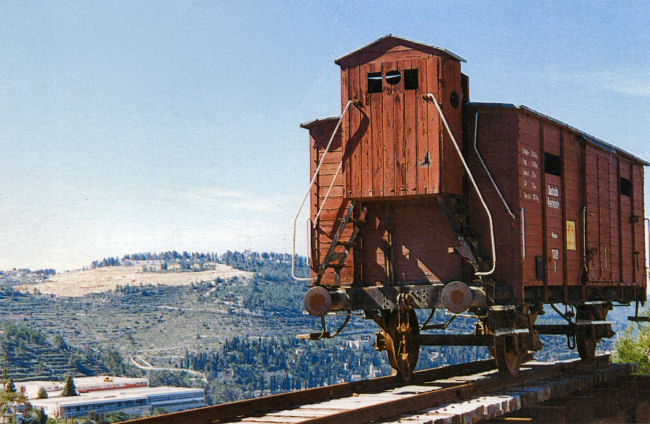
This cattle car used in
deportations is now in Yad Vashem. Heroes and Martyrs Memorial
Authority, Jerusalem, Israel and memorializes deportations of Jews from
across Europe to killing centres. Yad Vashem is "literally a monument
and a name," from Isaiah 56:5. The Israeli institution was established
by an act of the Israel Parliament on 19 August 1953. It is mandated to
gather into the homeland material regarding all those members of the
Jewish people who laid down their lives, who fought and rebelled against
the Nazi enemy and their collaborators, and to perpetuate their memory
and that of the communities, organizations, and institutions that were
destroyed because they were Jewish. (Photo: Naomi Kramer)
I felt the same fear as everyone on
the train—the fear of death. People often turn to religion when they are
scared—scared to die. Tefilah was said throughout the day because
there was nothing else to do—extra prayers for their fate—I do not know.
There was little need to measure time. Time was losing meaning but, on
the other hand, it was virtually all we had. I did not think about the
past—there was nothing to think about. My past life was not so pleasant
that I thought about it. There was nothing that stood out to think
about. There was nothing that I missed about my past days. The promise
of working and being together seemed more unlikely as time went on.
Without a gratifying past and the doubt of a promising future, I began
to feel desperate. |