|
Chapter 13: The Loew's Pitkin: Brownsville's Eyes on the World
In its almost
four-decade existence as a movie theater it played the top tier movies
immediately after their New York movie house runs. In addition to
5-act vaudeville shows, the programs also included the ever-present
Henrietta Kamern at the organ, a Robert Morton classic pipe organ which
was raised and lowered as needed. Henrietta accompanied the Follow the
Bouncing Ball singalongs, and served up rollicking music at the beginning
and end of major features. Occasionally the
theater featured Beauty Contests and eager younger movie crazed girls
would submit their photos which were displayed in the lobby. The
concession stand served up drinks, large sized candy (including jumbo
Tootsie Rolls, huge boxes of Nonpareils chocolate topped with white sugar
pellets, and of course, freshly made popcorn. Ushers were
elegantly dressed good-looking young males and reportedly used this
opportunity to meet and date young ladies of the neighborhood. The building, with
its Mayan inspired exterior was ringed on its Pitkin Avenue side with fine
retail establishments. Today, the inside has collapsed but retail
establishments of a lesser order still do business on the outer side of a
fake wall.
These are the nuts
and bolts. But in its heyday, in its glory, it was a whole lot more than
the sum of its parts. The Loew’s Pitkin was a pleasure palace, an escape
from the struggles and humdrum existence of this working class
neighborhood, its luxurious appointments and décor alone a sharp contrast
to the squalor in which many lived.
|
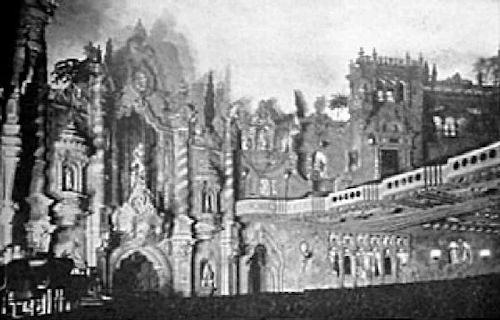
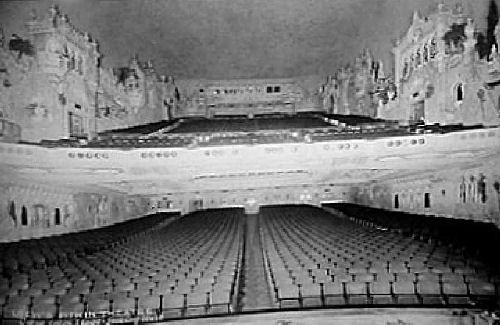
Recent
photos, prior to the collapse of the ceiling, show not only the vast
sizeof the
Loew’s Pitkin, but the scenic magnificence of the surrounding sides. Henrietta
and her beautifully stage-lit Robert Morton organ would emerge from
the left front.
And the orchestra pit was in front of the elaborate stage, in the
center. |
There was a Loew’s Pitkin for
everyone. For the reasonable price of admission, adults could enjoy at one
sitting, top rung dramas, comedies, lavish MGM musicals, mysteries or
westerns, paired with lower budget B pictures (some of which are now
prized as “film noir” classics) along with the latest newsreels and,
depending on the length of the main feature, additional short subjects.
Everything about the experience, from the moment you came up Pitkin Avenue
to the ticket booth, to your entrance, to the show itself was an escape.
You walked on lush carpeting, sat in comfortable seats and
enjoyed the best Hollywood could create.
|
 |
|
This is a
similar organ to the model played by Henrietta Kamern. |
Our mother went to
the movies by herself, either to the Pitkin or the Palace, usually on
Tuesday nights, which were less crowded and management gave every lady a
free dish. She loved the tearjerkers, especially the ones with Bette Davis
most of all, and had found that having a good cry in the theater was very
cathartic We developed a rating system for her. A really good one was a
five-hankie picture. Two or one hankie pictures were disappointments. She
would get dressed up, earrings and all, and put on a fancy hat for the
occasion. It was normal to see our
hard-working mother “all dolled up” for an evening at the movies by
herself.
Saturday night was
date night for young adults and teens. Unlike today, it was a time for
dressing up, making up and showing off. Males wore shirts, ties and suits,
adding dress coats with white silk scarves in winter. And it was cocktail
dresses and fancy hairdos, jewelry and the whole nine yards for young
ladies.
Couples in love spend the whole evening “making out” except for
interruptions by the ushers. Couples not really in relationship spend
the evening in a choreographed wrestling match. It goes something like
this. He buys their first round of treats and they find their seat. He
holds her seat for her, “like a gentleman." They settle in, make light conversation, nibble on
sweets or popcorn and sip some Coke or Pepsi. The lights dim and the
program begins. As the theater darkens and all eyes are on
the screen, a male hand reaches for one or another part of the female anatomy.
She knows what’s happening and has three options. She can push the hand
firmly away, leave it there passively but not respond, or jump right in
there with him and “make out.” If the hand is rejected, he tries blowing
in her ear and looking soulfully into her eyes, especially in conjunction
with a romantic portion of the movie.
The balconies were
the places of choice for serious ”making out” or heavy petting.
During breaks or
scheduled intermissions, you went to the lavish restrooms, and combed your
hair to be ready for the next round. Girls would re-do their makeup
sitting at mirrors, surrounded by flattering lighting.
If a girl came by
herself, and sat next to an empty seat, she would be easy prey for any
unattached male who would sit down next to her. And the games would begin.
Same choreography. The response was up to the girl. And if she really
disliked the fellow and he didn’t get the message, she would call the
usher, to make him either vacate the seat or leave the theater.
The balcony
section was popular for this sort of activity -- in general the loges were
too expensive, and the main section too out in the open.
The kiddie
matinees on weekends were a whole different matter. If the main film was
not considered appropriate for young eyes, or a hot kid movie was just
released, that would be part of the double bill. A special section was
roped off for kids and the aisles were heavily patrolled by
searchlight-bearing ushers and matrons.
Kids would come in
beginning with the opening of the doors around noon. They came with
sandwiches, fruit and treats from home or enough money for the treats from
the concession stand in the lobby.
Not only would the
youngsters see a double feature and news, but also an array of short
subjects, cartoons and that most popular kiddie favorite - the 12-part
serial. Evolving from the Perils of Pauline type serial, they would pit a
witless hero against equally witless villains. We called them, in
Brownsville vernacular, the “chapters.” There was a new chapter every
weekend, ending in a cliffhanger, literally. Sets were unconvincing to any
but young eyes. Kids cheered and booed and had a great time.
The hero, The Phantom, or the heroine, Perils of Nyoka,
would have found a
secret entrance to a room on the way down the cliff, or a way to disarm
the bomb that was about to go off. The intrepid Nyoka and her friends
would be pitted against Vultura, Queen of the Desert, on a quest for the
Golden Tablets of Hippocrates or some such treasure. And so on, to the
12th and final chapter. And then a new one would begin. The chapters kept
the kids coming on a regular basis -- no one wanted to miss finding out how
the hero/heroine was rescued. On kiddie matinee days, there were huge
signs at the movie house doors promoting the chapter and serial of the
day. Each chapter had a dynamic name, presaging Indiana Jones, names not
unlike The Temple of Doom, or Flaming
Inferno, or Railway of Death.
|
Ah, the
Perils of Nyoka - crushed by gorillas, about to be spiked to death
in the shrinking room. Kids waited eagerly, week to week, to see how
she would escape certain doom. |
I am an incurable
filmaholic and I watch Turner Classic Movies very often. So many of the
films I see there or on other channels of that type, I first saw at the
Pitkin, most of the 100 top films of all time. Casablanca, Best Years of
Our Lives, Gone with the Wind, Goodbye Mr. Chips, Mrs. Miniver, Lost
Horizon, all the MGM musicals. The Robert Mitchum film-noir adventures.
All the great comedies. The Pitkin was our eye on the world. Its newsreels
shaped and ignited our patriotism in wartime.
It was more than that. It was a destination, and a place from which images
flowed to inform, to entertain and to change thinking. And for us,
immigrants and the children of immigrants, caught up in our tight world of
work and school, it was how we absorbed American ideas and values.
Even to this day,
those who once lived in Brownsville speak with deep affection for this
movie theater. I feel it is a shame that it has been allowed to
deteriorate this far.
And I would
suggest if anyone reading these pages has the money or the means or both
to do something truly meaningful with it before there is any further
deterioration. I would imagine, in the light of the gentrification of
Brownsville, that the building could be restored and converted into a
museum of Brownsville’s colorful turbulent history as a way station for
different waves of immigration, while honoring the films that shaped two
generations.
|
Right hand page offers tickets to a Pitkin appearance in person of
The Three Stooges, in tandem with cartoons. |
If such a renovation were to come to fruition, it could revitalize Pitkin
Avenue and make it a destination again.
Postscript: The
fates of the lesser movie theaters in Brownsville and adjacent East New
York. The Hopkinson Theatre, originally a live Yiddish theater and at one
time a foreign film theater, was subsequently razed and is now a lot. The
Stadium, where B mysteries like Charlie Chan were shown, met a similar
fate and is now a small park. Loew’s Palace, the Supreme, the Ambassador,
the People’s Cinema (nee Bluebird), the Livonia, The Lyric (Hendrix),
Elite (Euclid), Kinema, Biltmore, Premier, Embassy, Warwick, Adelphi
(Gem), Gotham, have ALL been demolished. Those that remain as churches
include The Parkway, New Prospect (Ralph Ave.), the Montauk Arcade
(Montauk) and Brair’s Theatre (Powell) both on Pitkin Ave, the Penn,
Sutter, Miller (Jehovah’s Witness on site) all on Sutter Avenue.
Read From Holocaust to Herzl Street.
See photographs
of 130 former Brooklyn theatres.
©
2007 by Sylvia Siegel Schildt.
Ms. Schildt's book, "Brownsville: The Jewish Years," from which the above
excerpt was taken, can be purchased
here.
|