|
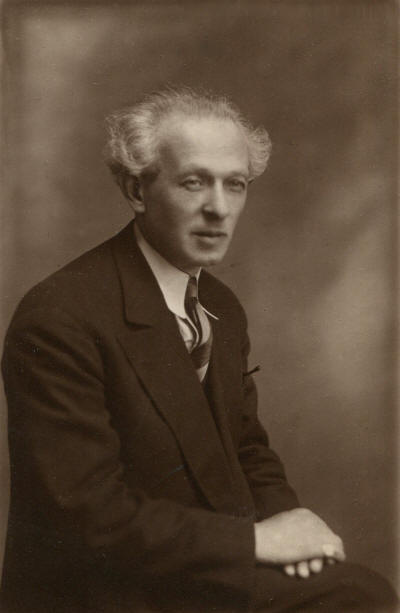
Anshel Schorr
|
|
Now, when there is so
much fuss in the press about the probes
[tests] that were first held by us not long
ago by the Actors' Union; Now, when the
Union is criticized so much for rejecting wanted, and for
accepting unwanted candidates; Now that
Comrade Ab. Cahan, the editor of the
"Forward" has raised the question of
whether those who judge the ability or
independence of the candidates themselves
are really capable of judging, -- now I
think, there will be room to acquaint the
readers, the press, and indeed the Actors'
Union, with this, as new members are being
recruited into the "Yiddish Artists' Union"
(Actors' Union) in Warsaw.
Earlier, however, I
would like to say a few words: with a word
from three years ago, when myself and my wife
(Dora Weissman), played in Warsaw. In a
letter in the "Forward", among others, it
was said that "the Yiddish Actors' Union
in New York may learn something from the
Yiddish Artists' Union in Warsaw." Now I
still have the "chutzpah" to think that the
large, rich union in America may learn from
the small, poor union in Poland.
But let us get to the
point, to the probes, how they are performed
in the Yiddish Artists' Union in Warsaw:
Here every candidate
goes through two probes, a "theatrical
probe" (literary test), and a "practical
|
|
probe" (in makeup and playing
theatre). Both probes are not given in front of the entire
Union, but for special committees.
The management of the union
(the Executive Board), consists of three pedagogues,
principals and teachers from the Yiddish schools, and
the candidate is given a theoretical exam by them. Each
candidate must be able to read, write and speak Yiddish
well. He needs to be at least a little familiar with
Jewish history, to know the history of Yiddish theatre,
and possess similar knowledge. When he gets through the
theoretical probe, the candidate will only then admitted
to the practical probe.
Also the practical probe is not
given before the entire union, but for a committee of
seven or nine, which consists of the best actors,
officially recognized directors, and a musician. I want
to mention that in no case does the committee include
those who have "pull," or are "makhers" (fixers) in the
union. It consists of the best forces from the Yiddish
theatre, such that one cannot suspect that they are
afraid of their job. As a "supervision committee," the
management (Executive Board) of the union and its
manager, the Executive Board has no vote, no opinion. It
sits only as a representative of the union, and it
ensures that everything goes smoothly. It answers
certain technical questions when asked.
Naturally, there are additional
rules and
regulations which I am not so precisely
familiar with, but these are the main points that are
shown to the candidates who are taken into the Yiddish
Artists' Union in Warsaw. I believe that it would be
great if the Yiddish Actors' Union in New York could
introduce a similar system. First, the union would be
freed from all criticism and would relinquish all
responsibility. When the union may include for the
"practical" probe a committee of our best actors,
according to recognized stars and stage directors, no
one would suspect them of dishonesty, and even
less so that they would reject a candidate because they
were afraid for their jobs.
Second, and this is a main thing,
until I'm sure the union would win very much with
it, if it had far fewer members than it has now.
I am sure that new members would
not have withstood the first "theoretical" probe, as
some of them could not even read Yiddish well and could
write even less. And in what other people in the world
could it exist that an actor could not speak his own
language? And it may be that this is why the public's
relationship to Yiddish theatre there in poor Poland is
much better, warmer than here in rich
America.
The average Yiddish actor does not
live much worse off in Poland than he does here in
America. True, one does not earn the great wages there
as here with us, but when one calculates the very cheap
standard of living there, and when one has it, it makes
sense that they play there fifty-two weeks a year, that
there is no season, not any slack -- perhaps the
actor there is better off than with us. During the
current season, many local actors would like to compete
with Polish actors.
I have before me a letter which I
first received this week from a prominent manager in
Poland. I give here only a few lines:
"I must also tell you, Mr. Schorr,
compared to the current world crisis, actors in Poland
are not feeling bad at all. Absolutely no worse than
before. A strange thing, here the public goes to the
theatre. True, that they play for quite cheap prices
(from 50 groshen to 4 zlotys). But they nevertheless
make seven to eight thousand a week alone. There is not
one unemployed actor. On the contrary, it lacks
actors ... I maintain a troupe on wages, and business is
not bad at all, they earn a dollar. In Warsaw now there
are five theatres: 'Kaminski,' 'Skala,' 'Novotschi,'
'Smocza,' and now there Fenigstein opens a new theatre
on Dzikagasse, the 'Central.' In my opinion this should
be a very good deal, but we'll see."
From the letter one can see in
certain relationships, the Yiddish actor in Poland is no
worse off than the average American actor. True, he
doesn't have the comfortable apartment with a private
bath, with the kibetsarnye. However, when it
comes to Passover, he does not hesitate: "Where will I
go to live in the summer," like many of our happy (?)
American actors. And there is, I believe, much to
thankful for, that this field is not overcrowded, as can
be seen from the quoted letter. "There is a lack of
actors," because not everyone is included in the union.
Yet public opinion is always with them.
When our Actors' Union also
introduces a similar system for the probes, I think it
is worthwhile for people to think about the plan and
also to discuss it. It would make me and many others
very happy when the editor of the "Forward," and the
manager of the union have a say in the method used by
the Yiddish Actors' Union in Poland. |


